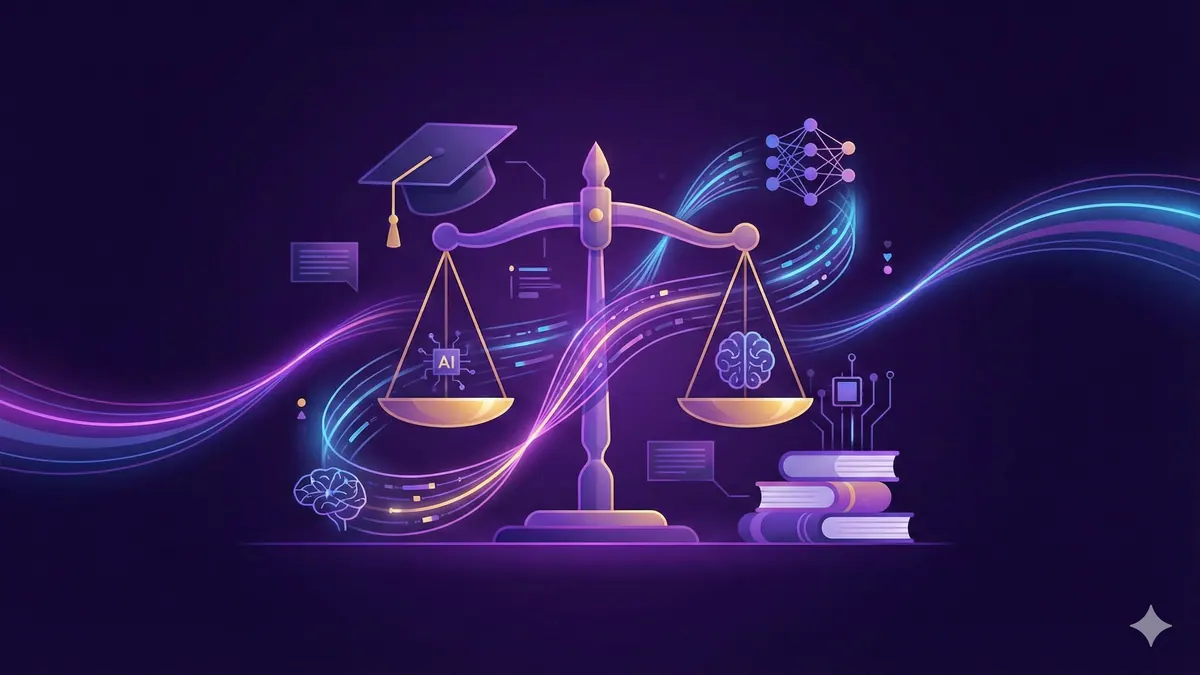
The rise of AI writing tools has sparked intense debate in educational institutions worldwide. Is using AI cheating? Where's the line between assistance and academic dishonesty? Let's explore both sides of this complex issue.
The New Reality
Since ChatGPT's release in late 2022, generative AI has become a routine part of education. Students use it for brainstorming, explanation, editing, and sometimes work that a course requires them to complete independently.
This has left educators scrambling to update academic integrity policies, often with contradictory results. Some schools ban AI entirely; others encourage it as a learning tool. The rules vary not just between institutions, but between departments and individual professors.
The Case Against AI in Academics
Learning Requires Struggle
Writing is thinking made visible. When you struggle to articulate an idea, you're actually processing and understanding it more deeply. Having AI write for you bypasses this crucial cognitive work.
Skill Development
Writing, research, and critical thinking are skills that require practice. If students outsource these tasks to AI, they may graduate without fundamental abilities expected by employers.
Fairness Concerns
Not all students have equal access to AI tools, especially premium versions. This creates an uneven playing field where wealthier students gain advantages.
Authenticity and Attribution
Submitting AI-generated work as your own is fundamentally dishonest. It misrepresents your abilities and undermines the trust that grades and credentials are meant to represent.
The Case For AI as a Learning Tool
It's Just Another Tool
Calculators didn't destroy math education—they enhanced it. Spell-checkers didn't end writing instruction. AI could be viewed similarly: a tool that handles mechanical tasks while humans focus on higher-order thinking.
Real-World Preparation
AI is becoming standard in most professional fields. Students who learn to use AI effectively—understanding its capabilities and limitations—may be better prepared for modern workplaces.
Democratizing Knowledge
AI can provide explanations, tutoring, and feedback that students might not otherwise access. For first-generation college students or those without academic support networks, AI can level the playing field.
Focus on Higher Skills
If AI handles basic writing mechanics, students and teachers can focus on critical thinking, argumentation, research skills, and creativity—arguably more valuable in an AI-enabled world.
Where Most Experts Land
The emerging consensus among educational researchers is nuanced: it depends on how AI is used.
Generally Acceptable Uses:
- Brainstorming and generating ideas
- Getting explanations of complex concepts
- Checking grammar and style
- Creating outlines or organizing thoughts
- Research assistance (finding sources, summarizing)
- Getting feedback on drafts you've written
Generally Problematic Uses:
- Having AI write entire assignments
- Submitting AI text as your own without disclosure
- Using AI on exams or assessments unless explicitly allowed
- Bypassing the learning process for skills you're meant to develop
The Problem with AI Detection
Many schools have turned to AI detection tools, but this approach has serious flaws:
False Positives
False positives occur, and the rate changes with the detector, text, language background, and evaluation setup. Turnitin says its report should be used as one data point rather than a definitive answer. A score alone should not decide an academic misconduct case.
Bias Issues
A peer-reviewed study found that several detectors disproportionately flagged writing by non-native English speakers. That documented bias is another reason to review context and writing process instead of treating a classifier as proof.
Cat and Mouse
Detection models and writing tools continue to change. Policies built around one vendor score can become brittle as models, prompts, and student workflows evolve.
Wrong Focus
Some educators argue that detection-based approaches focus on punishment rather than pedagogy. Better assessment design—oral exams, in-class writing, process portfolios—might be more effective than technological surveillance.
What Students Should Consider
If you're a student navigating this landscape:
Know Your Institution's Policy
Rules vary widely. Read your syllabus carefully and ask professors directly if you're unsure. "I assumed it was okay" is not a defense.
Consider the Purpose
Ask yourself: what is this assignment supposed to teach me? If using AI would bypass that learning, you're hurting yourself even if you don't get caught.
Be Honest
If you use AI, be prepared to disclose it. Many professors are open to AI assistance if students are transparent about how they used it.
Develop Real Skills
Don't let AI become a crutch. Make sure you can write, research, and think critically without AI assistance. These skills will serve you long after graduation.
What Educators Should Consider
For teachers and institutions:
Clear Policies
Ambiguity breeds violations. Be explicit about what's allowed and what isn't.
Rethink Assessment
Consider assessments that can't be easily outsourced: oral presentations, in-class writing, process documentation, personalized topics, reflection on learning.
Teach AI Literacy
Help students understand AI's capabilities and limitations. This is a crucial skill for their futures.
Focus on Learning
Rather than policing AI use, design courses that make genuine engagement more appealing than shortcuts.
The Bottom Line
AI in education isn't going away. The question isn't whether students will use it, but how. Both students and educators benefit from honest conversations about appropriate use, clear policies, and assessments designed for the AI age.
The goal of education—developing capable, ethical, knowledgeable people—remains unchanged. The tools and methods just need to evolve.
Humanize Your AI Content
When AI assistance is allowed but detection is still a concern, our tool helps ensure your content reads naturally.
Open AI Humanizer