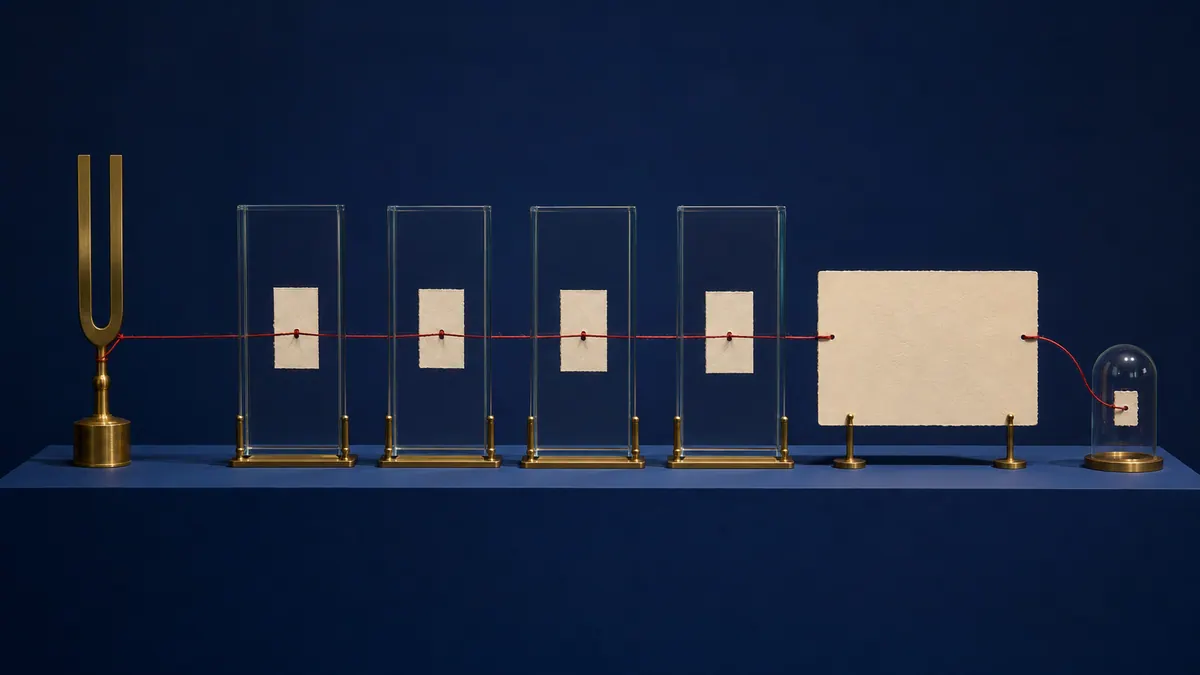
A quotation is not trustworthy because it looks precise. It is trustworthy when an editor can return from the published words to the right speaker, the original source, the exact location, the surrounding context, and every authorized change made along the way.
Quote Accuracy Is a Chain, Not a Pair of Marks
AI can help locate a passage, transcribe audio, summarize an interview, or tighten the prose around a quotation. It can also produce a fluent sentence that nobody said, merge remarks from different moments, attach real words to the wrong person, or preserve the wording while removing the condition that gave it meaning. A polished draft can hide a broken evidence chain.
The NIST Generative AI Profile, NIST AI 600-1, describes confabulation as confidently presented erroneous or false content and notes that generated outputs can include invented citations. Its content-provenance guidance recommends tracing the origin and modifications of digital content and documenting the limitations of provenance methods. That is a useful editorial principle: AI output may suggest where to look, but it is not the record that proves a quote.
This workflow is for accuracy, accountability, and responsible publication. It is not a method for fabricating evidence, disguising AI use, evading editorial review, or making unsupported text look authentic. It is also not legal advice. Copyright, recording, privacy, publicity, employment, defamation, consent, discovery, sector-specific, and disclosure rules vary by jurisdiction and context. Apply your organization’s policy and obtain qualified legal or compliance review when the stakes require it.
Define the Evidence Each Quote Must Carry
A reviewable quote should answer six questions. If one answer is missing, mark the quotation unresolved rather than letting the draft’s confidence fill the gap.
| Question | Evidence | Failure to Catch |
|---|---|---|
| Where? | Source artifact plus page, paragraph, line, clip, or timestamp | A quote copied from a summary or search snippet |
| Who? | Verified speaker or entity and role at that time | Namesakes, impostors, stale titles, or organizational mix-ups |
| What form? | Exact, shortened, translated, reconstructed, or paraphrased | Edited language presented as verbatim speech |
| What context? | Question, surrounding passage, date, setting, and material qualifiers | A true fragment that creates a false impression |
| What authority? | On-record status, consent, approval, license, and required disclosure | Accurate words published without the right to use them |
| Who checked? | Reviewer, date, decision, and escalation record | An unowned quotation that everyone assumes someone verified |
Start a Quote Ledger Before Rewriting
Create one row per proposed quotation before AI rewrites the surrounding draft. Give it a stable quote ID. Record the captured text, source title, source type, canonical URL or controlled file ID, publication or recording date, locator, speaker, role, original language, and the person who captured it. Add columns for the question or preceding passage, permitted edits, consent or approval status, reviewer, risk level, final wording, and every destination where the quote appears.
For a web source, keep more than a URL. Record the page heading or paragraph, access date, and a durable copy or archive when policy permits. For a PDF, use the printed page and the PDF page when they differ. For audio or video, keep the start and end timestamps, recording identity, transcript version, and enough nearby material to replay the sense. For an interview, record the date, channel, participants, and agreed ground rules.
The ledger extends the control described in The Protected Terms List. A protected list stops verified wording from drifting during a rewrite. A quote ledger begins earlier and goes further: it establishes whether the wording is truly a quote, traces where it came from, records context and permission, and follows the approved form into publication. Use both when exact language must survive revision.
Trace the Primary Source and an Exact Locator
Start from the closest available record: the complete recording, official transcript, signed statement, published decision, original post, research paper, or direct interview notes. An article quoting a report is not a substitute for the report. A social post quoting a broadcast is not the broadcast. A search result is a discovery aid, not a source artifact.
Open the artifact and navigate to the locator yourself. Confirm that the quoted words appear there and that the artifact is what it claims to be. Check the issuing domain, document title, author or office, date, version, and whether a correction or later edition exists. When a transcript was produced automatically, replay the audio. Small errors such as “can” for “can’t,” a missed number, or an incorrect speaker label can reverse a claim.
Do not treat an AI-generated citation, timestamp, or page number as verified until it resolves against the source. Record “not located” if the passage cannot be found. Replacing uncertainty with a plausible locator only makes the failure harder for the next reviewer to see.
Verify the Speaker or Entity
A real sentence can still be misattributed. Confirm the speaker’s identity through the primary artifact and an independent, authoritative reference where practical. Match the person’s role at the time of the statement, not merely today’s biography. For an organization, determine whether the language came from the organization, a named representative, a contractor, a customer, or an account that only resembled the official account.
The Reuters Journalistic Standards emphasize named sources where possible, clear ground rules, cross-checking, attention to impostors, honest attribution, and context. Your organization may use different editorial rules, but the underlying questions travel well: who supplied this, how do we know, what could they know, and what motive or limitation should the reader understand?
If identity remains uncertain, do not ask AI to infer it from tone, job title, or nearby names. Remove the quotation, attribute the document rather than a person when accurate, or escalate the unresolved identity.
Replay the Primary Record, Not a Quote Chain
Quote chains create source laundering. Draft A cites article B, which quotes post C, which summarizes clip D. Each handoff can drop a qualifier, mishear a word, or copy an earlier error. Follow the chain back to D and replay the complete relevant segment. If D is unavailable, say what the accessible source actually is instead of implying direct verification.
Compare the primary record with the draft character by character for consequential language. Then listen or read beyond the selected sentence. Capture the question being answered, the sentences before and after, the audience, and the date. Note nonverbal or delivery cues when they materially affect meaning. The goal is not to collect more context than anyone could use; it is to preserve the context needed to avoid a materially different impression.
Classify Exact Speech, Edited Speech, and Paraphrase
Do not use quotation marks as a decoration for vivid language. Assign each ledger row a form and publish it accordingly.
- Verified direct quote: wording and boundaries match the primary record. Quotation marks are appropriate.
- Shortened direct quote: omissions follow the chosen style and do not change meaning. The ledger preserves the full passage.
- Translated direct quote: a traceable translation is presented under a disclosed translation policy, with the original retained.
- Reconstructed speech: a participant remembers the substance but no verbatim record exists. Describe it as a recollection; do not silently present it as exact.
- Paraphrase or reported speech: the editor states the supported meaning in new words without quotation marks and still cites the source.
- Composite, illustrative, or AI-generated wording: never attribute it to a real person as something they said. Label fictional examples clearly or remove them.
The Reuters standards treat quotes as highly protected and caution against rewording a whole phrase; they recommend paraphrase when cleaning up speech would otherwise misrepresent it. That distinction is useful outside a newsroom too. If a real speaker’s grammar is distracting, reported speech is often more honest than a polished “quote” that preserves only the idea.
Use Brackets and Ellipses as Visible Change Controls
Choose a house style before editing quoted material and apply it consistently. The U.S. Government Publishing Office Style Manual collection includes the 2016 manual, whose official punctuation chapter provides detailed quotation-mark, bracket, and ellipsis treatment. It is a style authority for GPO work, not a universal rule for every publication, so use the authority that governs your context.
Use brackets only for a necessary clarification, substitution, translation note, or editorial insertion allowed by that style. The bracket must not smuggle in a conclusion the speaker did not make. Keep the unedited original in the ledger and record why the bracket is needed.
Use an ellipsis only when words were omitted and the remaining passage preserves the original sense. Do not stitch together separate answers, remove a decisive “not,” hide a condition, or join remarks from different dates. Punctuation cannot make a misleading excerpt fair. If the omission requires so much explanation that the quote becomes hard to read, paraphrase the supported point and link to the source.
Test for Context-Window Distortion
AI systems are good at selecting compact, quotable lines. Compact is not the same as representative. A sentence may answer a hypothetical, repeat an opponent’s claim, describe a plan that was later rejected, or depend on a definition several paragraphs earlier. A model may also retrieve the words but lose the date that limits them.
For every candidate, run a context-window check: read or replay enough before and after to identify the question, pronouns, scope, certainty, time frame, and outcome. Ask whether the excerpt reverses a denial, turns a possibility into a promise, generalizes a narrow case, or removes the speaker’s correction. Compare the quote with the source’s overall position. A literal fragment fails if its placement leads a reasonable reader toward a materially different meaning.
Disclose Translation and Preserve the Original
A translation can be faithful without being word-for-word, but it is still an editorial layer. Keep the original-language passage, source locator, translator or method, review status, and final translation together. State when a quotation was translated by the publication, supplied by the source, or produced with machine assistance and checked by a qualified human.
Reuters advises idiomatic translation that preserves tone and warns against translating a published translation back into an assumed original. Follow the same caution: return to the original recording or text whenever possible. For consequential language, use a reviewer competent in both the language and subject. If only a secondary translation is available, attribute that translation and disclose the limitation instead of presenting it as independently verified wording.
Record Consent, Approval, and Testimonial Risk
Accuracy does not settle permission. Record whether an interview was on the record, on background, off the record, or subject to a specific review agreement. Distinguish a factual confirmation from permission to rewrite. If a source approved exact wording, preserve the approved version and approval record; do not make a later AI-assisted polish silently.
Marketing testimonials need especially careful handling. The FTC’s Consumer Reviews and Testimonials Rule Q&A explains that testimonials are advertising messages and discusses fake or false testimonials, featured reviews, insider relationships, incentives, and AI avatars. FTC staff also states that the Q&A is not definitive or comprehensive and provides no safe harbor; context and facts matter.
For a customer quotation, preserve evidence that the person had the stated experience, the words reflect that experience, the intended use was authorized, and any material relationship or incentive is handled under applicable rules. Featuring a review in advertising may change its treatment. Never let a model draft praise and place it in a customer’s mouth, invent an experience, or turn conditional approval into open-ended permission.
Escalate High-Stakes Quotations
Use a higher review tier when a quotation concerns health, safety, law, finance, employment, elections, allegations, minors, trauma, confidential material, regulated claims, or a person’s reputation. Require a second reviewer who was not responsible for extracting the quote. Add subject-matter, legal, compliance, safeguarding, or translation review as appropriate.
The reviewer should inspect the primary source, identity, exact wording, context window, permission, disclosures, headline and caption, and the claim made around the quote. A correct quotation can become misleading when a headline exaggerates it or when adjacent prose claims more than the speaker did. Record the final decision, open limitations, and who accepted any residual risk.
Protect the evidence too. Interview recordings, identity records, consent messages, and unpublished transcripts may be sensitive. Store them under appropriate access, retention, privacy, and security controls. Do not paste confidential source material into an AI service unless the organization has authorized that use and the service arrangement meets the applicable obligations.
Worked Example: Repair a Webinar Quote
Suppose an AI tool extracts this line from a webinar transcript: “The update will eliminate review delays.” The sentence is clean, strong, and wrong. The ledger sends the editor to the official recording at 18:42. The speaker actually says, “In the pilot, the update may eliminate some first-review delays, but we do not have final data.” The automated transcript dropped “may” and “some,” while the draft removed the pilot condition and uncertainty.
The editor verifies the speaker on the event page and confirms her role on the webinar date. The source record becomes the official video, 18:38–19:06, with the transcript marked as a derived aid. The ledger keeps the full wording and context. The publication can use a careful direct excerpt — “the update may eliminate some first-review delays” — or paraphrase that early pilot results could reduce some delays, while preserving the lack of final data.
If marketing wants to use the excerpt as a customer testimonial, the workflow does not assume the webinar permission covers advertising. The team checks authorization, the speaker’s relationship, applicable disclosures, and the surrounding claim. One row now shows the source, locator, identity, form, context, permission, reviewer, and published destination. A future correction can follow the same chain back.
The Final Quote Provenance Checklist
- Every quote has a stable ledger ID, source artifact, and exact locator.
- The speaker or entity and role at the time are verified.
- The primary recording or text was replayed; AI output was not treated as proof.
- Direct, shortened, translated, reconstructed, paraphrased, and fictional wording are clearly distinguished.
- Brackets and ellipses follow the governing style and do not change the sense.
- The question, nearby passage, date, scope, uncertainty, and material delivery cues were checked.
- The original language and translation method remain traceable.
- Consent, approval, licenses, relationships, incentives, and disclosures were reviewed where relevant.
- High-stakes quotations received independent and specialist review.
- The headline, caption, and surrounding claims do not overstate the verified words.
- Sensitive evidence is stored under appropriate access and retention controls.
Quote provenance makes uncertainty visible before publication and corrections possible afterward. Let AI help search, transcribe, compare, or revise. Keep the decision to attribute real words to a real person with reviewers who can inspect the record and stand behind the result.
Want a Clearer Draft Around Verified Quotes?
Our AI humanizer helps you revise AI-generated text for clearer phrasing, more natural rhythm, and a voice you can review. It does not verify quotations, sources, speakers, permissions, translations, or legal compliance: keep those checks in your quote provenance workflow.
Open AI Humanizer