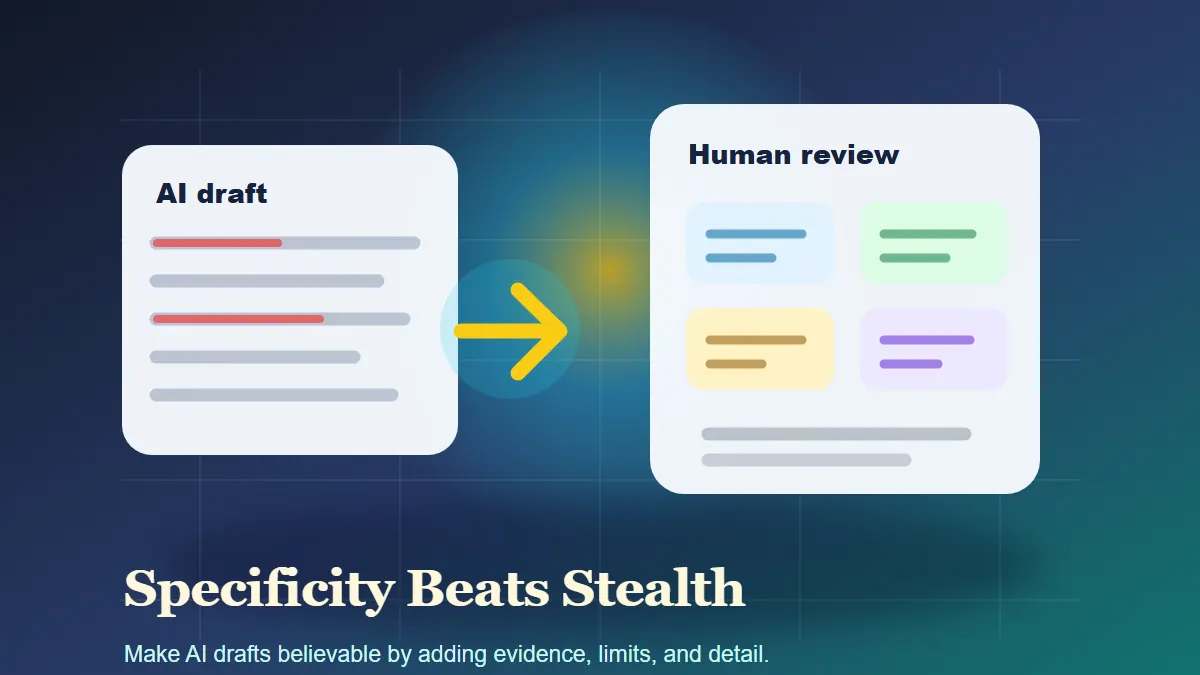
Most AI drafts do not fail because they are not hidden well enough. They fail because they are too general. The fastest way to make AI-assisted writing feel more credible is not to chase stealth. It is to add specificity, evidence, limits, and lived editorial judgment.
The Wrong Question
Many people approach AI-assisted writing with one anxious question: how do I make this sound less like AI?
It is an understandable question, but it often points the writer in the wrong direction. The goal becomes disguise instead of quality. The editor starts swapping words, adding random contractions, breaking sentence rhythm, and injecting casual phrases that do not actually improve the piece.
The result may sound less polished, but not more trustworthy.
A better question is simpler: what would a knowledgeable human writer know, notice, challenge, or include here?
General Writing Feels Unowned
AI drafts often sound plausible because they are built from common patterns. They know the shape of an explanation, the rhythm of a list, the tone of a professional paragraph, and the familiar conclusion that balances both sides.
That fluency is useful at the start. It is also the reason the writing can feel unowned.
A generic paragraph can say that teams should maintain transparency, improve collaboration, and use clear workflows. Those ideas are not wrong. They are simply not enough. The reader wants to know what kind of team, what kind of transparency, what breaks without it, and what a clear workflow looks like on Tuesday afternoon when deadlines are slipping.
Specificity gives writing fingerprints.
The Specificity Pass
After generating or drafting, read the piece once with only one task: find every sentence that could appear in almost any article on the same topic.
These sentences usually sound smooth. They often contain words like important, effective, meaningful, robust, valuable, essential, or dynamic. They are not always bad, but they usually need a job.
For each broad sentence, choose one of five upgrades:
- Add a concrete example.
- Name the audience or situation more narrowly.
- Include a constraint or tradeoff.
- Show what goes wrong when the advice is ignored.
- Replace the claim with a testable observation.
This single pass changes the draft faster than a thesaurus ever will.
Add Evidence, Not Decoration
Some writers try to humanize AI drafts by adding flavor words. They make the tone warmer, more casual, or more opinionated. That can help, but only if the substance is also stronger.
Readers trust evidence more than decoration.
Evidence does not always mean formal research. It can be a process detail, a customer example, a before-and-after comparison, a quote from a real conversation, a common failure mode, a metric, a screenshot, a limitation, or a decision rule.
For example, "review the draft for clarity" is weak. "Highlight every claim that does not name a person, place, number, tool, timeframe, example, or consequence" is stronger. The second sentence gives the reader something to do.
Use Limits To Create Trust
AI-generated content often overstates because it wants to be helpful. It can make a technique sound universal when it is only useful in certain conditions.
Human editing should add limits.
Instead of writing, "This workflow improves every marketing draft," write, "This workflow helps most when the draft already has a clear audience but lacks proof, examples, and a point of view."
Limits do not weaken the claim. They make it more believable.
A reader can feel when a writer knows where the advice stops working. That boundary is often what makes the advice worth trusting.
Replace Vague Authority With Situated Judgment
AI drafts often borrow authority from tone. They sound confident, organized, and complete. But confidence is not the same as judgment.
Judgment appears when the writer makes choices in context.
Which risk matters most? Which example is more useful? Which audience needs a warning? Which detail can be cut? Which claim should be softened? Which point deserves more force?
A strong editor does not merely polish sentences. A strong editor decides what the piece is responsible for.
Make The Draft Answer "Compared To What?"
One of the easiest ways to add specificity is to add contrast.
If the article says a tool is faster, compared to what? A blank page? A template? A previous workflow? A junior writer? A manual review queue?
If the draft says a sentence is more natural, compared to what? A formal corporate line? A keyword-stuffed paragraph? A generic AI summary?
Comparison turns vague praise into useful information. It also prevents the writing from sounding like an advertisement for an idea that has never been tested.
Keep The Human Mess Where It Helps
Not every sentence needs to be perfectly symmetrical. Real expertise often includes friction: an exception, a hesitation, a practical warning, or a detail that interrupts the clean pattern.
The point is not to add mistakes. The point is to add earned texture.
A human editor might write, "This sounds efficient, but it creates a review problem if no one owns the final claim check." That sentence is more useful than a broad reminder to maintain quality control.
Useful friction tells the reader that someone has actually thought about the advice in the real world.
A Practical Checklist
Before publishing an AI-assisted draft, run this checklist:
- Underline the broadest sentence in every section.
- Add one concrete example to each major claim.
- Name the reader or use case more precisely.
- Add one tradeoff, exception, or limitation.
- Replace abstract praise with a visible outcome.
- Cut any paragraph that repeats the same idea without adding proof.
- Read the conclusion and remove any sentence that could close a hundred other articles.
This is not about tricking a detector. It is about respecting the reader.
The Real Signal
AI detection tools look for patterns, but human readers notice something broader: whether the writing feels accountable to reality.
Does the piece know who it is talking to? Does it make claims it can support? Does it admit where the advice is limited? Does it include details that could only come from actual review, actual use, or actual thought?
That is the real signal.
Specificity beats stealth because specificity improves the writing even if no detector ever sees it. It gives the reader evidence that the draft has been handled by someone with judgment.
If AI gave you the first version, fine. Make the final version responsible.