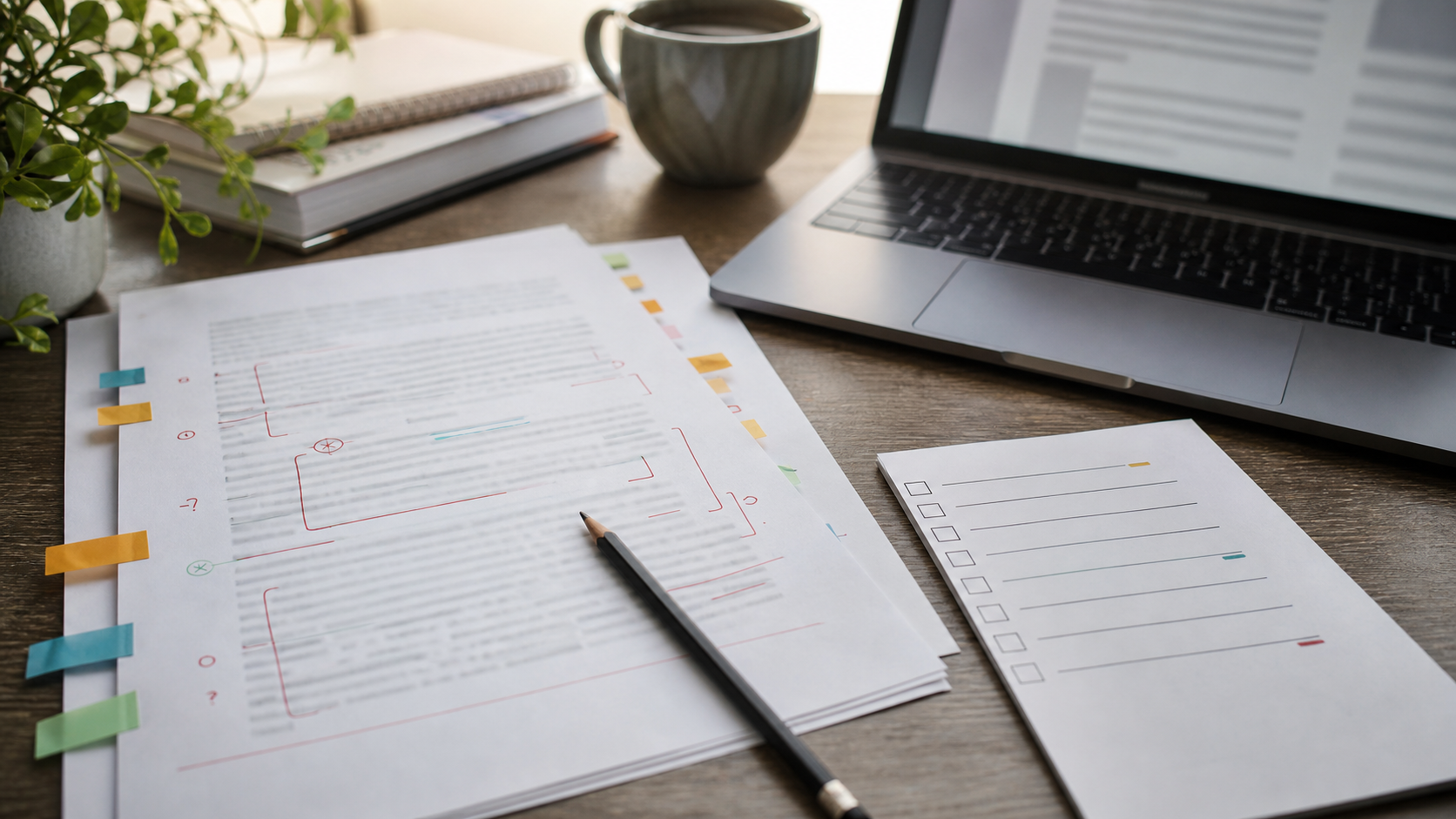
Use an accountability pass to check claims, decisions, examples, and missing judgment before publishing AI-assisted writing.
Polish Is Not The Same As Accountability
AI-assisted writing can become polished very quickly.
The grammar is clean. The tone is confident. The paragraphs have shape. The draft may even sound more finished than the messy human notes that produced it.
That polish can be useful, but it can also hide an important question:
Who is responsible for what this draft says?
An accountability pass is the editing step that answers that question. It checks whether the final piece contains claims a person can defend, examples a reader can recognize, recommendations that include context, and decisions that are visible enough to trust.
This is not about disguising AI use. It is about refusing to publish a smooth draft before a human editor has owned the meaning.
Start With The Claims You Would Have To Defend
The fastest way to find weak AI-assisted writing is to underline every claim that would require an answer if someone challenged it.
Look for sentences that say something is best, proven, common, risky, essential, emerging, effective, or widely used. Those words may be accurate, but they cannot be allowed to coast on confidence.
For each claim, ask:
- Do we know this is true?
- Is the claim too broad for the evidence behind it?
- Does it need a source, a caveat, or a narrower scope?
- Would a knowledgeable reader ask, "Compared with what?"
- Could this sentence harm trust if it is overstated?
Some claims should be sourced. Some should be softened. Some should be rewritten as observations instead of facts. Some should be removed entirely.
The point is simple: if a sentence cannot be defended, it should not be dressed up as certainty.
Make The Human Decisions Visible
One reason AI drafts feel slippery is that they often present conclusions without showing the judgment behind them.
A human editor can fix that by making decisions visible.
Instead of saying, "This workflow improves content quality," explain which part of quality it improves. Does it catch unsupported claims? Does it make examples more specific? Does it reduce review time? Does it create a record of what was checked?
Instead of saying, "Teams should use AI responsibly," name the responsibility. Who reviews the output? Which claims require verification? What cannot be delegated to the model? When should the draft be escalated to a subject-matter expert?
Visible decisions make writing easier to trust because they show that someone made choices, not just accepted fluent output.
Check The Examples For Real Constraints
Weak examples are one of the clearest signs that an AI-assisted draft has not been accountable to reality.
A generic example says, "A marketing team can use AI to create better copy."
An accountable example says, "A marketing team can use AI to draft three landing page variants, then require a human editor to verify product claims, pricing language, customer promises, and compliance-sensitive phrases before a variant goes live."
The second example has constraints. It names the work. It shows the review responsibility. It gives the reader something to evaluate.
During the accountability pass, improve examples by adding one or more real-world limits:
- Who is using the draft?
- What decision are they trying to make?
- What could go wrong if the output is accepted too quickly?
- What must a human verify?
- What does a better final version change?
Examples do not need to become long. They need enough friction to feel observed.
Look For Advice That Skips The Hard Part
AI-assisted writing often gives advice that is technically true but operationally thin.
"Add more detail."
"Use a natural voice."
"Check for accuracy."
"Understand your audience."
None of these instructions are wrong. The problem is that they skip the part where a reader needs to know what to do next.
An accountability pass turns advice into a usable action.
"Add more detail" becomes "Replace one abstract sentence in each section with a specific scenario, number, constraint, or consequence."
"Use a natural voice" becomes "Read the paragraph aloud and remove phrases you would not say to a real client, teacher, customer, or teammate."
"Check for accuracy" becomes "Mark every statistic, policy claim, product feature, date, and legal or medical statement for verification before publishing."
Accountability is not only about being correct. It is about making the next responsible action clear.
Add A Short Decision Trail
For higher-stakes writing, keep a short decision trail outside the published piece.
This can be as simple as a note beside the draft:
- AI helped create the first structure and alternate phrasings.
- Human editor verified product claims against current documentation.
- Pricing details were removed because they change often.
- Legal advice language was replaced with a recommendation to consult qualified counsel.
- Examples were rewritten from internal customer-support patterns.
This note does not need to be public in every context, but it helps the writer, reviewer, or team remember what was checked and why.
It also makes future updates easier. When a page changes six months later, the next editor can see which parts depended on current facts, internal judgment, or outside review.
Use AI As A Reviewer, Not The Final Owner
AI can help with the accountability pass if it is given a narrow review role.
Ask it to list unsupported claims, identify vague advice, find missing caveats, or challenge examples that feel too generic. Ask it to play the role of a skeptical customer, cautious teacher, compliance reviewer, or busy reader.
Then treat its output as a checklist, not a verdict.
The model can surface issues. It cannot decide what your organization can promise, what your evidence supports, which risks matter most, or what your reader deserves to know.
That final ownership belongs to a person.
The Trust Test Before Publishing
Before publishing an AI-assisted draft, ask one final question:
Can a real person stand behind this page if a careful reader asks how we know, why we recommend it, and what limits apply?
If the answer is no, the draft needs more than style polish.
It needs clearer claims, stronger examples, visible judgment, and a better record of what was checked.
That is what the accountability pass provides.
It turns fluent writing into responsible writing.
It makes the human editor visible in the final result.
And it gives readers a reason to trust the work for reasons deeper than how smooth it sounds.
Need A More Accountable AI Draft?
AI Undetectable helps turn flat AI text into clearer, more natural writing while preserving the meaning and judgment your final draft needs.
Try Free →