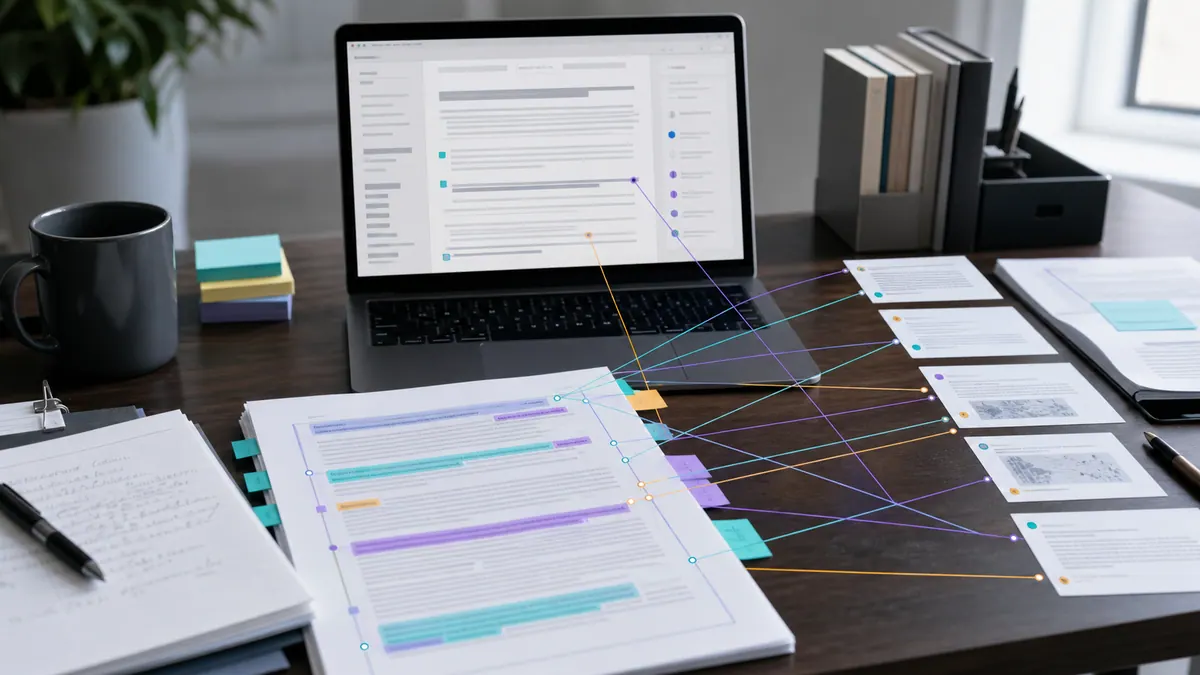
An assumption audit helps you find the hidden leaps, invented context, and unsupported confidence that can make AI-assisted writing sound smooth but unreliable.
Fluent Drafts Can Hide Quiet Inventions
AI-assisted writing often fails in a subtle way.
It does not always make an obvious factual error. It may not cite a fake study, misspell a product name, or invent a quote. Instead, it quietly fills gaps.
It assumes the reader already agrees. It assumes a customer has the same problem as the example. It assumes a claim is generally true because it sounds plausible. It assumes a policy is simple. It assumes a workflow works the same way for a freelancer, a student, an enterprise team, and a regulated company.
The result can sound polished while resting on weak ground.
An assumption audit is a practical editing pass for that problem. It asks one question again and again: what is this draft acting as if it knows?
That question is useful because AI writing often hides its assumptions inside confident transitions. A sentence like "This is why teams should..." may skip over whether the "this" was proven, whether the team context was defined, and whether the recommendation applies to the reader in front of you.
The audit does not make the writing less useful. It makes the usefulness earned.
Underline Claims That Depend On Missing Context
Start by scanning the draft for claims that rely on information the piece has not actually established.
Look for sentences that begin with broad language:
- "Most users..."
- "Teams need..."
- "The best way..."
- "This proves..."
- "Readers will..."
- "Businesses should..."
Those phrases are not automatically wrong. They are signals to check.
If the draft says "most users," ask how it knows. Is that based on product data, customer interviews, public research, or just a reasonable-sounding guess? If the draft says "teams need," ask which teams. A five-person agency does not have the same review process as a bank, a university department, or a legal team.
Many AI drafts become more credible when broad claims become bounded claims.
"Teams need a single approval process" might become "Teams that publish high-risk claims need a clear approval path, while lower-risk drafts may only need a checklist and owner review."
The second sentence is less sweeping, but it is more useful because it names the condition.
Separate Evidence From Plausibility
Plausibility is not the same as evidence.
A draft can sound right because it matches common advice. It can also sound right because the wording is smooth and familiar. That does not mean the claim has support.
During the assumption audit, mark each important claim as one of three types:
- Evidence-backed: the draft has a source, example, product data, direct observation, or clear reasoning.
- Plausible but unsupported: the claim may be true, but the draft has not shown why.
- Invented or overextended: the draft goes beyond what the available information can support.
This classification helps you decide what to do next.
Evidence-backed claims may only need cleaner wording. Plausible but unsupported claims need a source, a narrower frame, or a softer wording. Invented or overextended claims should be cut or rewritten.
For example, "AI detectors often punish non-native writers" is a serious claim. If the draft includes a credible source or a careful explanation of false-positive risk, it can stay. If the draft only says it because it sounds like a useful warning, it needs support or a narrower version.
A stronger sentence might be: "Because detector scores can be uncertain and may vary by writing style, they should not be used as the only evidence in a high-stakes decision."
That version avoids pretending to know more than the draft can prove.
Check The Reader The Draft Imagines
AI writing often invents a reader.
Sometimes the imagined reader is too generic. Sometimes the reader has unlimited time, full authority, perfect source access, and no constraints. Sometimes the reader is treated as if they only care about detection, when they may also care about originality, policy, accuracy, reputation, or fairness.
Ask these questions:
- Who does this advice assume is reading?
- What level of authority does the draft assume they have?
- What risks does it assume they can ignore?
- What tools, sources, or permissions does it assume they possess?
- What would change if the reader were a student, marketer, founder, teacher, editor, or compliance reviewer?
This step often exposes why a draft feels thin. The advice may be technically correct for one reader but wrong for another.
"Run the draft through a humanizer before publishing" is incomplete advice for a student working under an academic policy. It may also be incomplete for a company writing medical, financial, legal, or employment-related content. In those settings, the core problem is not only whether the prose sounds human. The problem is whether the work is allowed, accurate, disclosed where required, and reviewed by the right person.
A reader-aware draft does not flatten those differences.
Find The Missing Step Between Problem And Recommendation
AI drafts often move quickly from diagnosis to solution.
"AI writing can sound generic, so add personal examples."
That may be good advice, but there is a missing step: what makes an example safe, relevant, and true?
If a draft skips that step, the recommendation can lead to weak writing. The reader may add a made-up customer story, a vague anecdote, or a personal detail that does not support the argument.
During the assumption audit, look for places where the draft jumps from problem to instruction. Then add the bridge.
For example:
"Add examples that can be verified. A useful example should name the setting, the constraint, and the outcome without inventing private details or turning one case into universal proof."
That bridge makes the recommendation more practical. It tells the reader what kind of example counts.
Use Counterexamples To Pressure-Test The Draft
A good assumption audit includes at least one counterexample.
Pick a central claim and ask, "When would this not be true?"
If the draft says "shorter sentences sound more human," the counterexample is literary or technical writing where rhythm, precision, or necessary detail matters more than shortness.
If the draft says "a conversational tone improves trust," the counterexample is a safety policy, legal notice, or formal academic explanation where casual phrasing may weaken credibility.
If the draft says "AI can speed up content production," the counterexample is a topic where review time, source checking, and stakeholder approval take longer than drafting.
Counterexamples do not destroy the article. They sharpen it.
After you find one, rewrite the claim so it survives the pressure. The result is usually clearer, fairer, and harder to dismiss.
Ask AI To Critique Its Own Hidden Assumptions
AI can help with this pass if you give it a narrow role.
Useful prompts include:
- "List the assumptions this draft makes about the reader, context, and available evidence."
- "Find claims that sound confident but are not supported inside the draft."
- "Where does this draft move from problem to recommendation too quickly?"
- "Give me three counterexamples that would make the main advice less true."
- "Rewrite the broadest claims so they are more precise without becoming timid."
These prompts are helpful because they turn AI into a pressure tool instead of a polishing machine.
Still, the editor has to choose. AI may flag too much, miss business-specific risk, or suggest caveats that make the article dull. Keep the assumptions that matter to accuracy, trust, and reader usefulness. Cut the rest.
End With A Cleaner Contract With The Reader
Every article makes a contract with the reader.
It says, "You can trust me to guide you through this topic."
Unsupported assumptions break that contract. They ask the reader to accept confidence in place of care.
The assumption audit repairs the contract before publication. It checks what the draft thinks it knows, narrows what it cannot prove, and adds the missing context that makes advice usable.
Before publishing an AI-assisted piece, ask:
"What is this draft acting as if it knows?"
Then make the answer visible.
When assumptions are named, tested, and corrected, AI-assisted writing stops sounding merely smooth. It starts sounding accountable.
Review Your Draft in One Workspace
Use AI Undetectable to evaluate writing patterns, revise awkward phrasing, and compare the result before you publish. Detector scores are signals, so keep the final factual and editorial review in human hands.
Open AI Humanizer