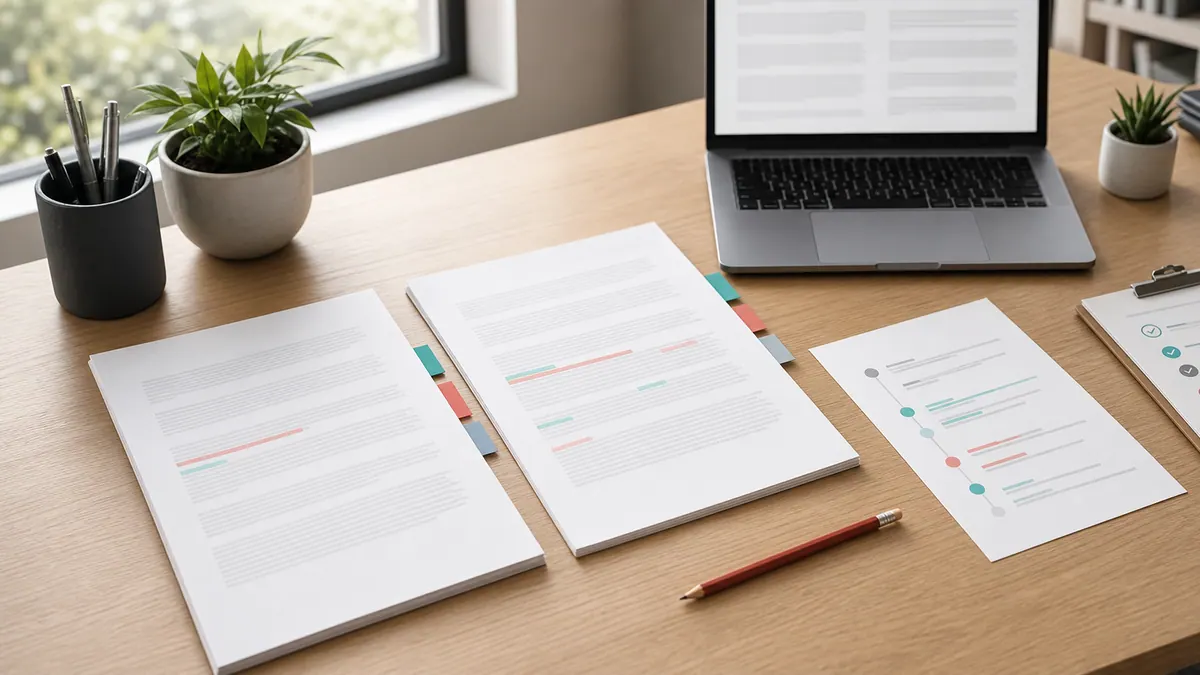
The change log pass turns AI-assisted revisions into reviewable decisions so editors can see what changed, why, and what still needs judgment.
AI-assisted editing can make a draft cleaner very quickly.
That speed is useful, but it creates a problem: the final version may look better while the reasoning behind the edits disappears. A reviewer sees smoother paragraphs, tighter sentences, and a more confident structure, but they cannot easily tell which changes improved meaning and which changes quietly moved the draft away from the original intent.
The change log pass solves that problem.
It is a short review step where you record the most important AI-assisted revisions before the draft is treated as finished. The goal is not bureaucracy. The goal is traceability. A good change log lets a human editor inspect the decisions behind the polish.
Final Copy Is Not The Whole Record
AI tools are good at making revision look effortless. They can compress a paragraph, change the tone, reorganize a section, and replace vague wording in a single pass.
But when all of that happens at once, the review surface becomes too flat.
The editor no longer knows whether a sentence was changed for clarity, accuracy, voice, compliance, search intent, or simple preference. That matters because different kinds of changes deserve different levels of scrutiny.
A typo fix is low risk.
A new claim is high risk.
A tone adjustment may be harmless in one context and unacceptable in another.
The change log pass brings those differences back into view. It gives each meaningful edit a reason, and it gives the reviewer a faster way to decide what needs a second look.
Use Three Columns
The simplest version of this pass uses three columns:
- Change: what was altered.
- Reason: why the alteration was made.
- Review note: what still needs human judgment.
You do not need to log every comma. The pass is for changes that affect meaning, emphasis, structure, evidence, audience fit, or brand voice.
For example:
- Change: shortened the opening from six sentences to three.
- Reason: removed repeated setup and reached the practical point sooner.
- Review note: confirm the shorter opening still names the reader's problem clearly.
That entry is small, but it tells a reviewer where to look and what question to ask. It also keeps the edit from becoming invisible.
Separate Polish From Position
One of the most important distinctions in AI-assisted revision is the difference between polish and position.
Polish changes how a point is expressed.
Position changes what the draft is actually saying.
Polish includes trimming wordiness, smoothing transitions, removing repeated phrases, and making sentence rhythm more natural. These changes still deserve review, but they usually do not change the argument by themselves.
Position changes are different. They include stronger claims, broader promises, new causal language, altered recommendations, and any sentence that makes the reader believe more than the source material supports.
AI tools often blur this line because confident language can look like better writing. The change log pass makes the line explicit.
If the AI turned "may help" into "will solve," log it.
If it changed "some teams" into "most teams," log it.
If it turned an example into a general rule, log it.
These are not just style edits. They change the responsibility carried by the sentence.
Flag Source-Sensitive Edits
The highest-risk AI edits are often the ones that sound most useful.
A model may add a cleaner explanation, a stronger statistic-shaped phrase, a more decisive conclusion, or a more complete list of causes. The writing may improve, but the evidence trail may not.
Use a source-sensitive flag for any edit that touches:
- Numbers, percentages, or comparisons.
- Legal, medical, financial, or academic claims.
- Customer promises or product capability language.
- Quotes, paraphrases, or source summaries.
- Recommendations that could affect a reader's decision.
The flag does not mean the edit is wrong. It means the edit needs evidence, not just better wording.
A good review note might say:
"AI added a stronger conclusion here. Verify against the source before publishing."
That kind of note saves time because it sends the reviewer directly to the risk instead of asking them to reread the whole draft with equal suspicion.
Keep Before And After Examples Short
A useful change log is not a second draft.
When a revision is important, include a short before-and-after snippet. Keep it small enough that the difference is obvious.
Before: "This tool can be helpful for people who want to improve drafts in a number of different ways."
After: "This tool helps editors tighten drafts without losing the original point."
Reason: the revised version names the user, the action, and the constraint.
Review note: confirm "without losing the original point" is supported by the workflow being described.
This format keeps the focus on editorial judgment. It does not ask the reviewer to admire the smoother sentence. It asks them to verify that the smoother sentence is still true.
Use The Pass Before Approval, Not After
The change log pass is most valuable before a draft is approved.
If you create the log after publication, it becomes documentation. If you create it before approval, it becomes a quality filter.
Before approving the draft, scan the log and ask:
- Did any edit add a claim that did not exist before?
- Did any edit remove nuance that the reader still needs?
- Did any edit make the voice sound cleaner but less specific?
- Did any edit change the promise of the article?
- Did any edit need source verification that has not happened yet?
These questions are faster than reviewing from scratch because the log points to the pressure points. It also helps teams avoid a common AI workflow problem: everyone assumes someone else checked the important changes.
What This Pass Prevents
The change log pass prevents three common failures.
First, it prevents silent drift. A draft can become more polished while slowly changing its claim, audience, or level of certainty.
Second, it prevents review fatigue. Reviewers do not have to treat every line as equally risky when the log identifies the edits that matter.
Third, it prevents false confidence. A clean final draft can feel finished because it reads smoothly. The log reminds the team that smoothness is not the same as approval.
That is the real value of the pass.
It lets AI help with revision while keeping human responsibility visible.
The final draft may be cleaner, shorter, and easier to read. But the review record still shows what changed, why it changed, and where judgment still belongs.
Review Your Draft in One Workspace
Use AI Undetectable to evaluate writing patterns, revise awkward phrasing, and compare the result before you publish. Detector scores are signals, so keep the final factual and editorial review in human hands.
Open AI Humanizer