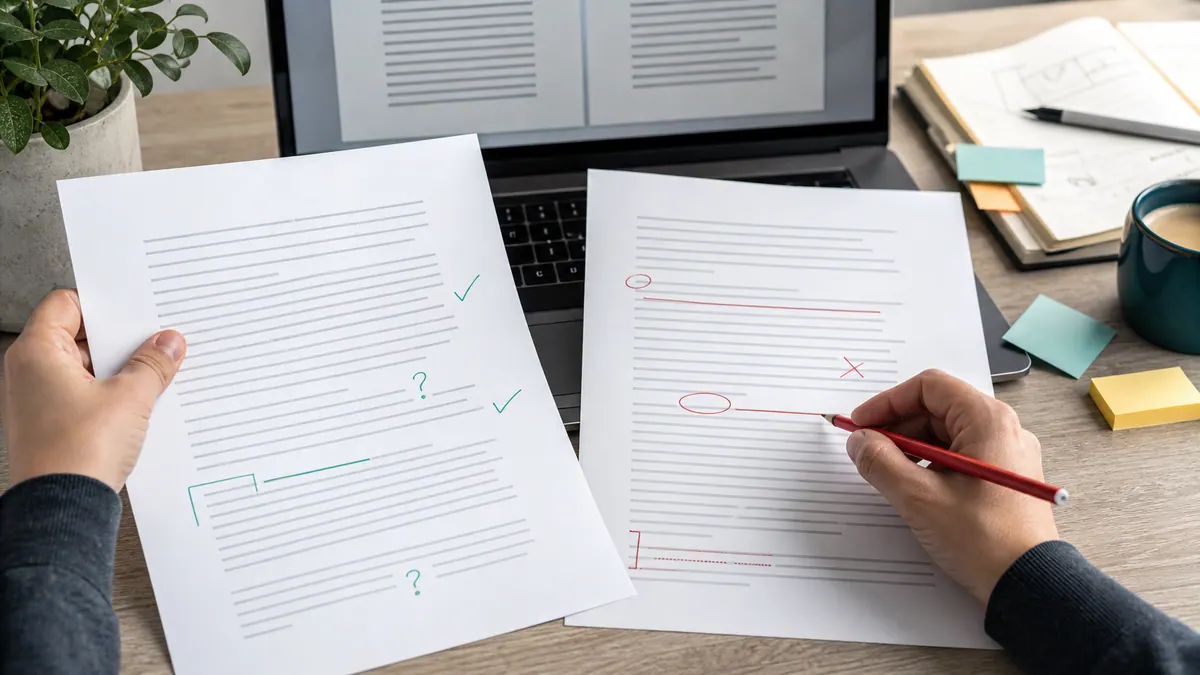
A counterexample pass helps teams stress-test AI-assisted claims before publishing by looking for exceptions, edge cases, and missing limits.
Strong Drafts Need Friction
AI-assisted drafts often improve quickly when you ask for polish.
The paragraphs become smoother. The transitions become cleaner. The argument sounds more complete. That can be useful, but it also creates a risk: the draft may become easier to believe before it has been tested.
The counterexample pass is a way to add useful friction.
Instead of asking, "How can this sound better?" you ask, "Where could this be wrong, incomplete, or too broad?"
That question changes the revision process. It moves the draft from confidence to responsibility. It helps you catch claims that are mostly true but not always true, advice that works in one context but fails in another, and sentences that sound persuasive because no one has pushed back yet.
Start With The Claim That Sounds Too Easy
The best place to begin is the sentence that feels effortless.
AI drafts often produce clean generalizations: "This workflow saves time," "Teams can rely on AI for first drafts," "Clearer prompts produce better writing," or "Humanizing tools make content sound natural."
Some of those claims may be fair. The problem is the missing limit.
A counterexample pass asks what would make the sentence less true.
Maybe the workflow saves time only after the team has examples and review standards. Maybe AI first drafts are useful for internal memos but risky for legal claims. Maybe better prompts help, but only if the writer also checks the evidence. Maybe a humanizer improves rhythm, but the final draft still needs a human review for accuracy and voice.
The goal is not to weaken every sentence. The goal is to make confidence match reality.
Use Three Counterexample Questions
You can run the pass with three practical questions.
First: "When would this not work?"
This question finds boundaries. It helps you identify cases where the advice, product claim, or workflow is not appropriate. If the draft says a process works for every team, ask about regulated teams, small teams, non-native English writers, classrooms, customers with low trust, or urgent deadlines.
Second: "Who would disagree for a good reason?"
This question finds legitimate objections. A teacher, editor, compliance reviewer, support lead, or customer may have a reason to challenge the draft. You do not have to accept every objection, but you should know which ones are reasonable.
Third: "What example would make this claim look naive?"
This question finds missing specificity. If one realistic example can make the sentence sound careless, the sentence probably needs a limit, a better example, or a narrower claim.
Turn Counterexamples Into Better Sentences
A counterexample is not automatically a reason to delete a claim.
Often it is a reason to improve the claim.
Suppose the draft says: "AI-assisted writing helps teams publish faster."
A counterexample might be: "Not if the team spends more time verifying unsupported claims than it saves on drafting."
The improved sentence could be: "AI-assisted writing can help teams move faster when they pair drafting with a clear review step for facts, examples, and voice."
That version is less flashy, but it is more useful. It tells the reader what has to be true for the claim to hold.
Suppose the draft says: "Detector scores show whether text is safe to submit."
A counterexample might be: "Detector scores can be wrong, and different systems may disagree."
The improved sentence could be: "Detector scores are useful signals, but they should be treated as one part of a broader review that includes originality, sourcing, and human judgment."
The edit does not hide uncertainty. It makes the recommendation more trustworthy.
Look For The Unsupported Universal
Universal language is one of the clearest signs that a counterexample pass is needed.
Watch for words like always, never, everyone, no one, guaranteed, fully, completely, every, only, and best.
These words are not banned. Sometimes they are accurate. But they carry a heavy burden.
If the draft says "always," you need to know what happens when the reader finds one exception. If the draft says "guaranteed," you need to know whether the product, policy, or evidence can actually support that promise. If the draft says "the best," you need a comparison standard.
Most AI-assisted business writing becomes stronger when universal claims become conditional claims.
"This always works" becomes "This works best when..."
"Every team needs this" becomes "Teams with this problem often benefit from..."
"This guarantees trust" becomes "This makes the draft easier to trust because..."
Conditional language is not weak. It is accurate.
Separate Edge Cases From Core Cases
One risk of the counterexample pass is overcorrecting.
If you chase every rare exception, the draft can become cautious to the point of uselessness. Readers still need a clear recommendation.
The solution is to separate edge cases from core cases.
A core case is the normal situation your reader is likely facing. An edge case is real but less common, narrower, or outside the article's promise.
You do not need to rewrite the whole piece around every edge case. You do need to avoid pretending they do not exist when they matter.
Sometimes one phrase is enough:
- "For short marketing drafts..."
- "In low-risk internal documents..."
- "When source material is already verified..."
- "For teams that have an editor or reviewer..."
- "This is not a substitute for legal, medical, or academic review..."
Those limits help the right reader trust the advice, and they keep the wrong reader from misusing it.
Use AI To Generate Objections, Not Final Approval
AI can help with this pass if you assign it the right job.
Do not ask, "Is this article good?" That invites vague approval.
Ask for pressure instead:
- "List five realistic cases where this claim would not hold."
- "What would a skeptical editor challenge in this paragraph?"
- "Which sentences make promises that need limits?"
- "Where does the conclusion go beyond the evidence?"
- "Rewrite this claim so it stays useful but becomes more defensible."
Then review the output yourself.
The model can produce possible objections, but it cannot take responsibility for what you publish. Human review still has to decide which objections are fair, which are edge cases, and which require a real change.
End With A Claim You Can Stand Behind
The counterexample pass is not about making writing timid.
It is about making writing sturdy.
A sturdy draft can survive a skeptical reader because it has already considered the obvious pushback. It does not make promises it cannot support. It does not hide exceptions that matter. It knows the difference between a useful general rule and an unsupported universal.
That is what better AI-assisted writing needs.
Not just cleaner sentences.
Not just lower detector risk.
Clear claims, visible limits, practical examples, and enough editorial friction to make the final draft something a real person can stand behind.
Review Your Draft in One Workspace
Use AI Undetectable to evaluate writing patterns, revise awkward phrasing, and compare the result before you publish. Detector scores are signals, so keep the final factual and editorial review in human hands.
Open AI Humanizer