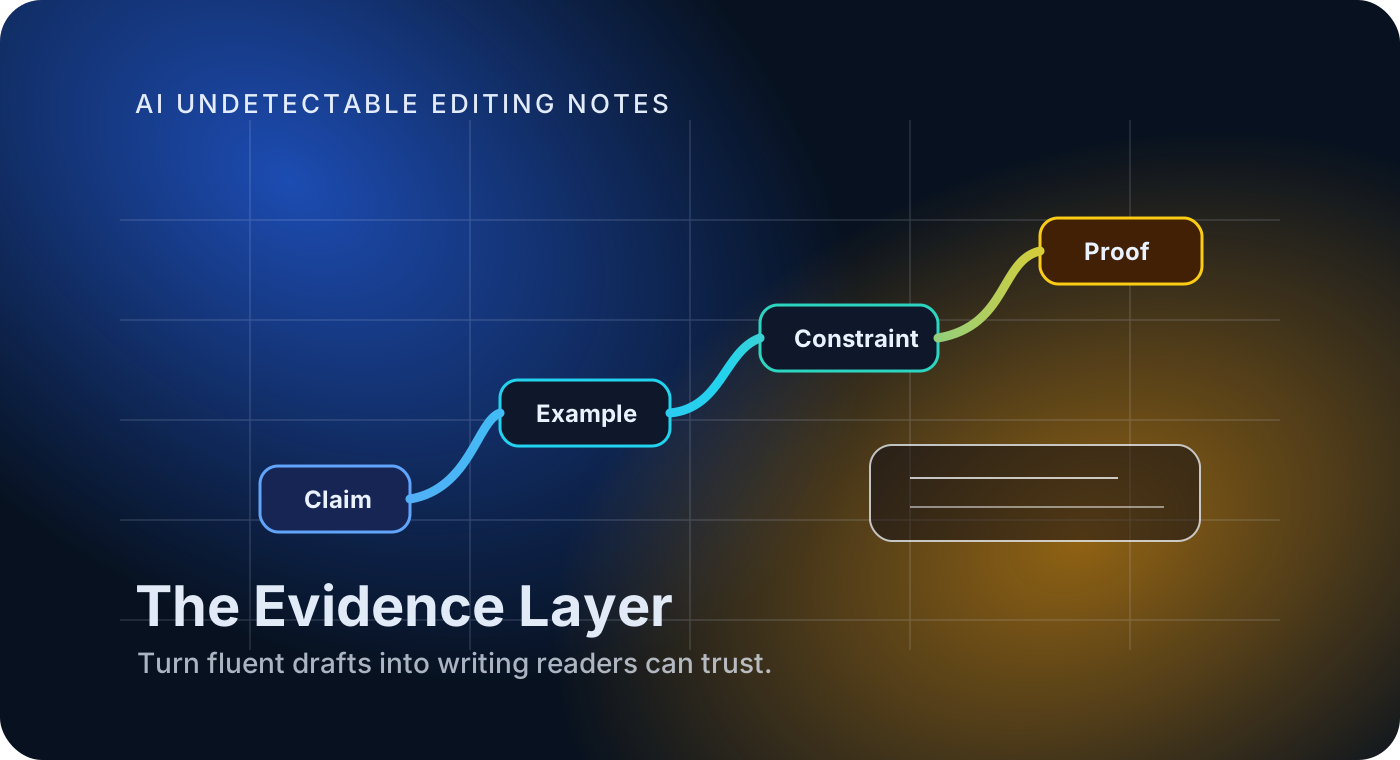
Fluent AI drafts can still feel untrustworthy. The missing piece is often the evidence layer: the claims, examples, constraints, and proof that show a real writer has tested the argument.
Fluency Is Not Trust
AI writing has become very good at sounding finished. It can produce clean introductions, tidy headings, balanced paragraphs, and confident conclusions. The surface may be smooth enough that nothing looks obviously wrong.
But readers do not trust writing because it is smooth. They trust it because the piece appears to have touched reality. It names specific situations. It makes claims that can be inspected. It admits limits. It connects ideas to examples, numbers, observations, tradeoffs, and consequences.
That layer is often missing from AI-assisted drafts. The text explains the topic, but it does not prove that anyone has looked closely.
What the Evidence Layer Means
The evidence layer is the part of a draft that answers a reader's quiet question: "Why should I believe this?"
It does not always mean academic citations. In many business, marketing, or practical articles, evidence can be a concrete example, a visible process, a constraint, a comparison, a test result, a customer objection, or a realistic edge case.
A draft without evidence relies on tone. A draft with evidence relies on contact with the world.
The Four Evidence Moves
Most weak AI drafts can be improved by adding four kinds of evidence.
- Claims: What exactly are you saying is true?
- Examples: Where can the reader see that claim in action?
- Constraints: When does the claim stop being true?
- Proof: What observation, data, process, or consequence supports the claim?
AI drafts often include claims, but the claims are broad. They may say AI tools improve productivity, AI detectors can create false positives, or human editing improves quality. These statements may be reasonable, but by themselves they are weightless.
The evidence layer gives those statements friction.
Before and After
Generic: AI-generated content can be improved by adding human creativity and personal examples.
With evidence: AI-generated content usually becomes more credible when the editor replaces abstract advice with details only a participant would know: the failed first attempt, the tradeoff the team debated, the phrase customers kept misunderstanding, or the example that forced the argument to become narrower.
The second version does more than sound better. It shows the kind of evidence that would actually change the reader's experience.
Why Detectors Are Not the Main Audience
People often add randomness to AI drafts because they are trying to reduce detector risk. They break sentences, swap vocabulary, add casual phrases, and hope the pattern looks less machine-made.
That can backfire. Randomness without purpose makes writing look worse to humans. It may also leave the deeper problem untouched: the draft still has no lived specificity, no accountable claims, and no real constraints.
Evidence is a better editing target because it improves the piece even if no detector ever sees it. A paragraph with a clear claim, a concrete example, and a stated limit is more useful to a reader. It also tends to avoid the sterile uniformity that makes AI writing feel suspicious in the first place.
The Claim Audit
Start by underlining every sentence that makes a claim. Do not underline description or background. Underline statements that ask the reader to accept something as true.
Then ask three questions:
- Is this claim specific enough to disagree with?
- Does the paragraph show an example of the claim?
- Would a skeptical reader know what evidence supports it?
If the answer is no, revise before polishing style. A beautiful sentence that makes an unsupported claim is still unsupported.
The Example Test
An example should not be decorative. It should change the reader's understanding.
Weak example: "For example, many teams use AI for writing."
Stronger example: "A marketing team might use AI to generate ten landing page variants, then discover that all ten repeat the same vague benefit. The human edit is not just rewriting sentences. It is choosing the one customer objection the page must answer."
The stronger example creates a scene. It shows a decision. It makes the abstract point testable.
Add Constraints Before the Reader Does
Trustworthy writing often sounds less absolute than generic AI writing. That is not weakness. It is precision.
If you say, "AI detectors are unreliable," a careful reader may resist. If you say, "AI detectors can be unreliable when they are used as final proof instead of one signal among several," the claim becomes more credible because it has boundaries.
Constraints show judgment. They tell the reader you are not trying to win by exaggerating.
Proof Can Be Process
Not every article needs statistics. Sometimes the proof is the process itself.
If you are writing a guide, explain the decision sequence. If you are comparing tools, explain the test conditions. If you are giving editing advice, show the before and after. If you are making a policy argument, describe the failure mode that creates the policy need.
Process evidence is especially useful for AI-assisted writing because it demonstrates human judgment. It shows that the final text was not merely generated. It was examined.
A Five-Minute Evidence Pass
After an AI draft is complete, do this before editing for rhythm:
- Underline the three most important claims.
- Add one concrete example under each claim.
- Add one sentence that limits or qualifies the claim.
- Replace one vague noun with a specific object, role, scenario, or metric.
- Rewrite the conclusion so it returns to the strongest piece of evidence, not just the topic.
This pass is small, but it changes the authority of the piece. The draft stops performing confidence and starts earning it.
The Point
The evidence layer is what separates fluent text from accountable writing. It is the difference between saying the right kind of thing and showing why that thing deserves attention.
If you want AI-assisted writing to feel more human, do not begin by adding quirks. Begin by adding contact with reality. Name the claim. Show the example. Admit the constraint. Explain the proof.
That is how a draft becomes less like output and more like work someone was willing to stand behind.