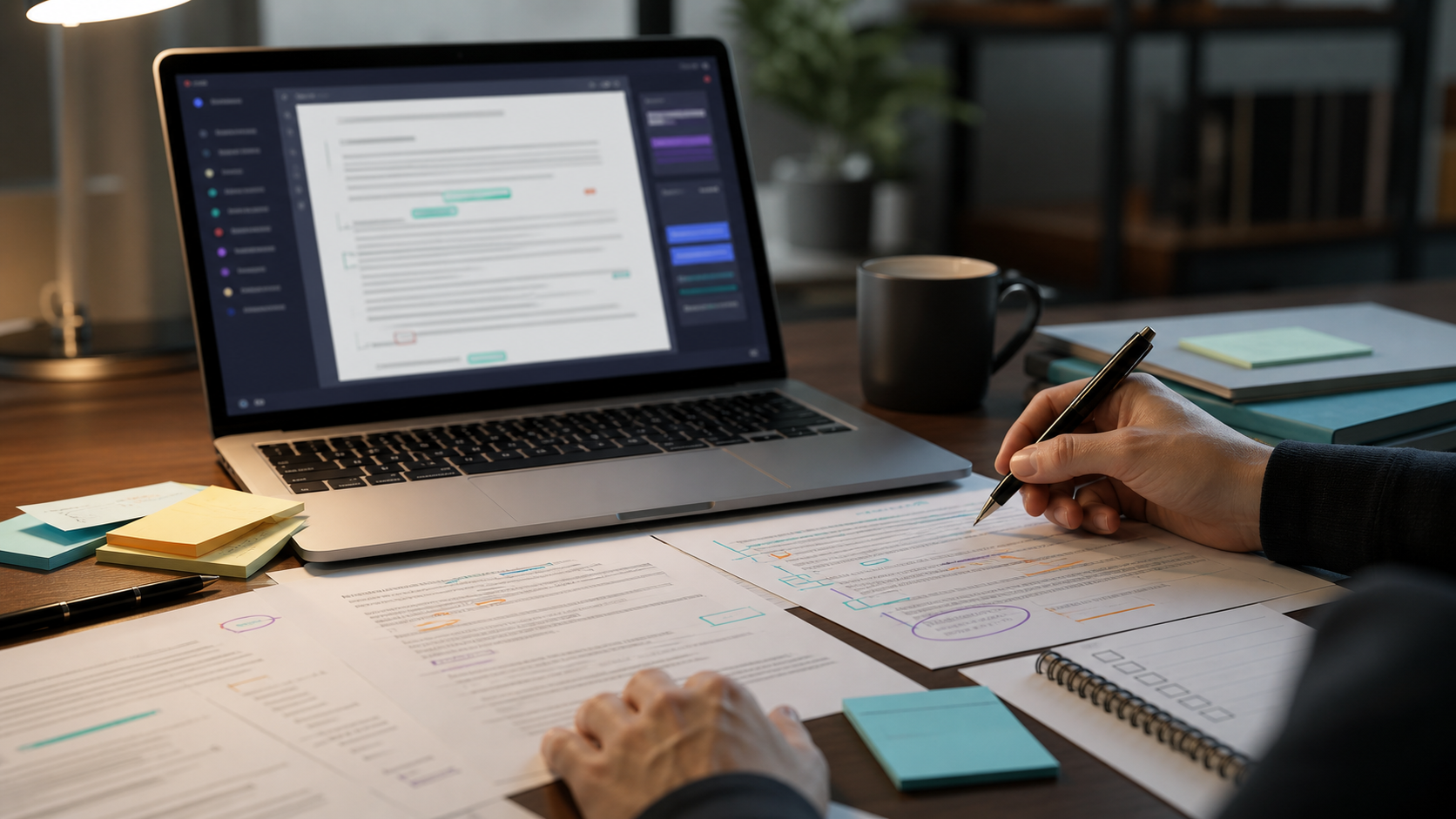
An ownership pass turns a smooth AI draft into writing you can defend by adding decisions, limits, examples, and reasoning behind claims.
Readable Is Not The Same As Owned
An AI-assisted draft can become readable very quickly.
The sentences may be clear. The headings may be tidy. The conclusion may sound confident. But when you slow down and ask a harder question, the draft may still feel unfinished: could you stand behind this if someone challenged it?
That is where the ownership pass comes in.
The ownership pass is a human edit focused on responsibility. It is not only about making the draft sound more natural. It is about making sure the writing contains your judgment, your context, your limits, and your willingness to answer for what the piece says.
AI can help you generate structure, options, examples, and language. But ownership is the part the model cannot supply for you.
What Ownership Looks Like On The Page
Owned writing has a few recognizable qualities.
It names the situation it is speaking to. It explains why a recommendation makes sense. It includes examples that come from real use cases. It qualifies claims when the evidence is limited. It avoids pretending that a general idea applies to every reader in every context.
Most importantly, owned writing sounds like someone made decisions.
A generic AI draft often says, "This strategy can improve productivity and build trust with your audience."
An owned version says, "For a small marketing team publishing one article a week, this review step helps because it catches product inaccuracies before they reach customers."
The second sentence has a situation, a reason, and a consequence. It gives the reader something to evaluate. That is the texture of ownership.
Start With The Claims You Would Defend
Before you polish voice, mark the sentences you would need to defend.
Look for recommendations, predictions, warnings, comparisons, statistics, promises, definitions, and statements about what readers should do. These are the places where ownership matters most.
Ask a simple question beside each one: "Would I be comfortable explaining why this is here?"
If the answer is yes, strengthen the sentence by adding context. If the answer is no, decide whether the claim needs evidence, a narrower scope, a softer verb, or removal.
This step keeps the draft from hiding behind fluency. A sentence can be elegant and still be unsupported. A paragraph can sound authoritative and still be too broad.
Add The Missing Decision
Many AI-assisted drafts summarize ideas without making a clear editorial choice.
They say a tactic is useful, but not when. They describe a risk, but not how serious it is. They mention a process, but not which step matters most. They offer a list, but not a priority.
The ownership pass adds the missing decision.
Before: "Human review is important when using AI writing tools."
After: "Human review should happen before publication, not after, because that is where factual accuracy, tone, legal constraints, and customer-specific examples can still be corrected."
The revised version does more than sound better. It takes a position. It tells the reader where judgment belongs and why.
Replace Universal Advice With Conditions
Generic drafts often speak universally because universal language is easy to generate.
"Every business should..."
"The best approach is..."
"Writers must always..."
Sometimes those phrases are simply too large for the evidence behind them.
Owned writing uses conditions. It says who the advice is for, when it applies, and when it might not.
For example, instead of saying, "Always use AI to draft your first version," you might write, "AI can be useful for a rough first structure when the writer already has a clear brief, source material, and a plan for human review."
That sentence is more trustworthy because it has boundaries. It is not trying to win every possible case. It is helping a real reader make a better decision.
Show Your Reasoning
Readers do not only need conclusions. They need to see how you arrived at them.
AI drafts often skip that middle layer. They jump from a broad problem to a polished recommendation without showing the reasoning that connects them.
During the ownership pass, add the bridge.
If you recommend adding examples, explain that examples reveal whether the writer understands the audience. If you recommend checking sources, explain that fluent phrasing can make unsupported claims feel more certain than they are. If you recommend cutting vague authority phrases, explain that readers trust specific evidence more than borrowed confidence.
This does not mean every paragraph needs a long explanation. It means the major claims should have visible logic.
Bring In One Real Example
A single real example can change the entire feel of an AI-assisted piece.
Not a vague example like "a company using AI for marketing." A shaped example.
Try something like: "A customer support team turns a week of help desk notes into a draft knowledge-base article. The AI creates the outline, but a support lead adds the exact error messages, removes unsupported promises, and rewrites the steps in the order customers actually follow."
That example has a setting, a role, a source, and a human decision. It gives the reader a concrete situation instead of a floating concept.
If your article has no examples like this, the ownership pass should add at least one.
Check The Words That Overpromise
Ownership also means noticing where the draft promises more than it can deliver.
Words like "guaranteed," "always," "never," "proven," "best," "instant," and "foolproof" should earn their place. In many AI drafts, they do not.
You do not need to make every sentence timid. Strong writing can still be clear and confident. But confidence should come from the strength of the claim, not from inflated wording.
Often, the fix is simple.
"This guarantees better results" becomes "This can improve results when the draft is checked against real source material."
"This works for every writer" becomes "This is most useful for writers who already know the audience and need help organizing the first pass."
The revised sentences are less dramatic and more credible.
Use AI As A Critic, Not The Owner
AI can help with the ownership pass if you give it the right job.
You can ask it to find unsupported claims, identify vague authority language, list places where examples would help, or turn broad claims into conditional statements. You can ask it to compare the draft against a brief, a source document, or a style guide that you provide.
But the model should not become the final authority on accuracy, ethics, legal risk, medical claims, product claims, or policy details. If the draft depends on a fact or a promise, verify it outside the model before publishing.
The best use of AI here is as an attention tool. It can help you notice what needs ownership. It cannot take ownership for you.
A Practical Ownership Checklist
Use this checklist after the draft has a workable structure and before the final line edit.
- Highlight every claim, recommendation, and promise.
- Ask whether you could explain why each important claim is there.
- Add the situation, audience, or constraint behind broad advice.
- Replace vague authority with specific reasoning or evidence.
- Add at least one real example with roles, source material, and a human decision.
- Qualify claims that are true only in certain conditions.
- Cut sentences that sound confident but have no support.
- Only then polish the voice, rhythm, and transitions.
This order matters. If you polish before you take ownership, unsupported claims become harder to cut because they start to sound finished.
The Best Humanizer Is Judgment
People often think humanizing AI writing means changing the surface: shorter sentences, more varied rhythm, fewer predictable phrases, warmer transitions.
Those edits can help. But the deeper human signal is judgment.
Judgment says, "This is the reader I am speaking to." It says, "This claim is true only under these conditions." It says, "This example came from a real workflow." It says, "This sentence is too broad, so I am cutting it."
That is what makes AI-assisted writing feel like someone is present behind the page.
Not because the draft is trying to hide its tools.
Because the writer has made the draft answerable.
The ownership pass turns a fluent draft into a piece you can defend. It gives the writing a point of view, a set of limits, and a human being willing to stand behind the final words.