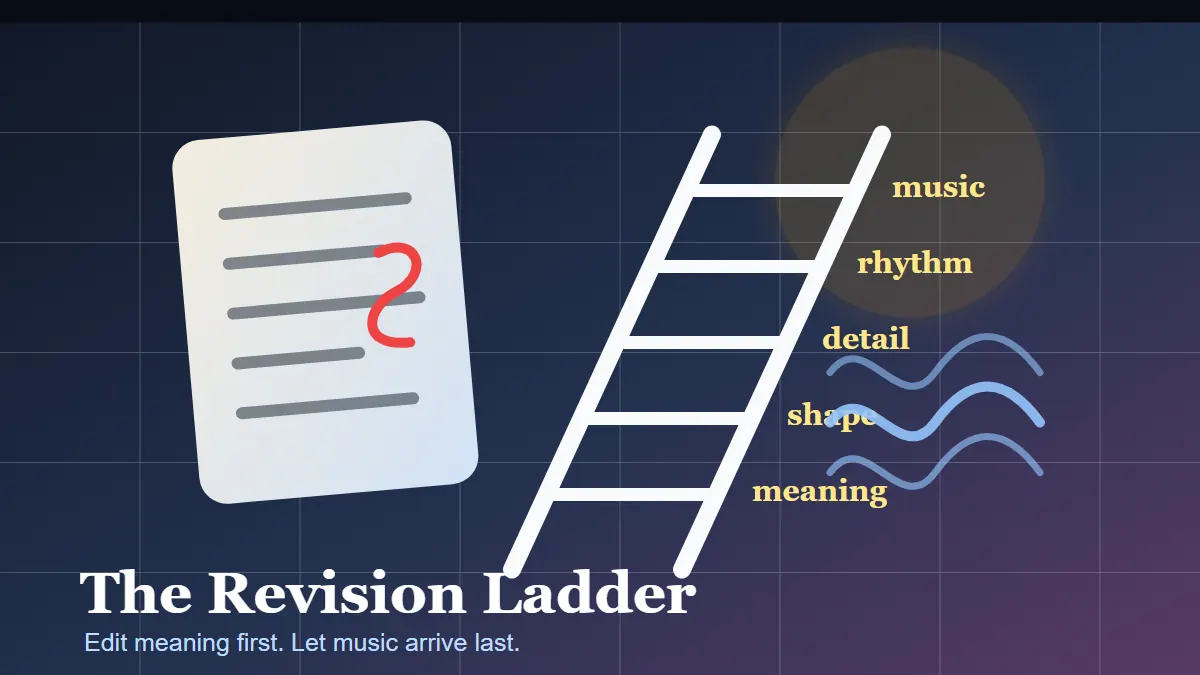
Most weak revision happens in the wrong order. The writer polishes a sentence before the paragraph knows what it is doing. The comma gets attention before the claim has a spine. The draft becomes prettier without becoming clearer.
A better way to revise is to climb a ladder. Start at the bottom, where meaning lives. Move upward through promise, structure, evidence, sentences, rhythm, and final proofing. Do not skip rungs. If you edit music before meaning, you may produce a beautiful paragraph that should have been deleted.
Rung One: Meaning
The first revision question is not, Does this sound good? It is, What am I actually saying?
Many drafts begin as fog with moments of light. You circle a topic. You collect facts. You gesture toward an idea. Somewhere in the middle, a sentence finally arrives with force. That sentence is often the real beginning.
Before changing style, write the core idea in one plain sentence. No metaphor, no flourish, no cleverness. If the piece is an essay, name the argument. If it is a product page, name the promise. If it is a story, name the human change.
Try this: This piece is really about... If the answer feels vague, keep revising at the meaning level. Vague meaning cannot be rescued by elegant prose.
Rung Two: Reader Promise
Every piece makes a promise to the reader. Sometimes it is explicit: This guide will help you revise your draft. Sometimes it is emotional: Stay with me and you will understand this strange feeling. Sometimes it is practical: By the end, you will know what to do next.
A draft fails when it promises one thing and delivers another. A title about clarity becomes a lecture about productivity. An opening about grief turns into a generic list of tips. The reader feels the drift even if they cannot name it.
Circle the first three paragraphs and ask: What promise have I made? Then read the ending and ask: Did I honor it?
Rung Three: Shape
Structure is not decoration. It is the route the reader takes through your thinking. A good structure does not merely arrange sections. It creates movement.
Look for the natural sequence. Does the reader need context before advice? A problem before a method? A story before an argument? A contradiction before a conclusion?
One useful structural test is to write a one-line summary of every paragraph in the margin. If two paragraphs do the same job, merge them. If paragraph six should clearly come before paragraph three, move it. If a paragraph has no job, it is not a paragraph. It is a guest who wandered into the kitchen.
Rung Four: Evidence and Detail
Once the structure works, inspect the substance. Where are you asking the reader to trust a claim without enough detail? Where have you used a broad word because you did not choose a real example?
Abstract nouns are useful, but they need grounding. Do not only say a process is frustrating. Show the cursor blinking at 11:48 p.m. while the sentence still refuses to land. Do not only say a team lacks alignment. Show three people leaving the same meeting with three different definitions of done.
Specific detail is not extra. It is how the reader verifies that the writer has actually seen the thing.
Rung Five: Sentence Clarity
Now you can work on sentences. Clarity usually improves when you remove delay. Many sentences walk around the house before opening the front door.
Look for throat-clearing phrases:
- It is important to note that...
- In today's world...
- There are many different ways that...
- Due to the fact that...
These phrases are not crimes. They are often just nerves. Cut them and see if the sentence stands taller.
Also check whether the subject and verb arrive early. A sentence becomes easier to follow when the reader quickly knows who is doing what.
Rung Six: Rhythm
Rhythm is where prose begins to breathe. It is not about making every sentence short. It is about variation, pressure, and release.
Too many long sentences make the reader swim through syrup. Too many short sentences can feel choppy. The ear wants contrast. A long sentence can gather complexity, delay the turn, and carry the reader toward a small surprise. Then a short sentence can land.
Read a paragraph aloud. Mark where you run out of breath. Mark where your voice becomes bored. The body is an editor. It knows when a sentence has stayed too long.
Rung Seven: Music
Music is the final layer: sound, echo, texture, the exactness of a word, the little snap of a closing phrase. It matters. It is also dangerous to chase too early.
A musical sentence attached to a weak idea is like a chandelier in a house with no floor. Lovely, briefly, then concerning.
At this stage, choose verbs with more life. Replace repeated words unless the repetition is intentional. Listen for accidental rhyme, heavy alliteration, and phrases that sound impressive but mean less than they seem to.
The goal is not ornament. The goal is inevitability: the feeling that this sentence could not have been said much better another way.
A Small Example
First draft:
In today's fast-paced digital landscape, communication is a very important skill for professionals who want to be successful and connect with people effectively.
Meaning revision:
At work, unclear communication turns small tasks into expensive confusion.
Detail revision:
The missing sentence in a project brief can become three meetings, two Slack threads, and a deadline nobody trusts.
Rhythm revision:
One missing sentence can become three meetings, two Slack threads, and a deadline nobody trusts.
The final version is not fancy. It is better because it moved down the ladder first. It found the meaning, then the image, then the rhythm.
The Revision Order
Use this checklist the next time a draft feels almost right but not alive:
- Meaning: Can I say the point plainly?
- Promise: Does the opening match the ending?
- Shape: Does each section move the reader forward?
- Evidence: Are the claims grounded in concrete detail?
- Clarity: Can sentences be shorter, cleaner, or more direct?
- Rhythm: Does the paragraph breathe when read aloud?
- Proofing: Are spelling, punctuation, links, names, and facts correct?
One Last Rule
Do not ask a first draft to be final. Ask it to show you what it knows. Then climb.
Revision is not a punishment for bad writing. Revision is writing becoming more honest about what it meant to say all along.