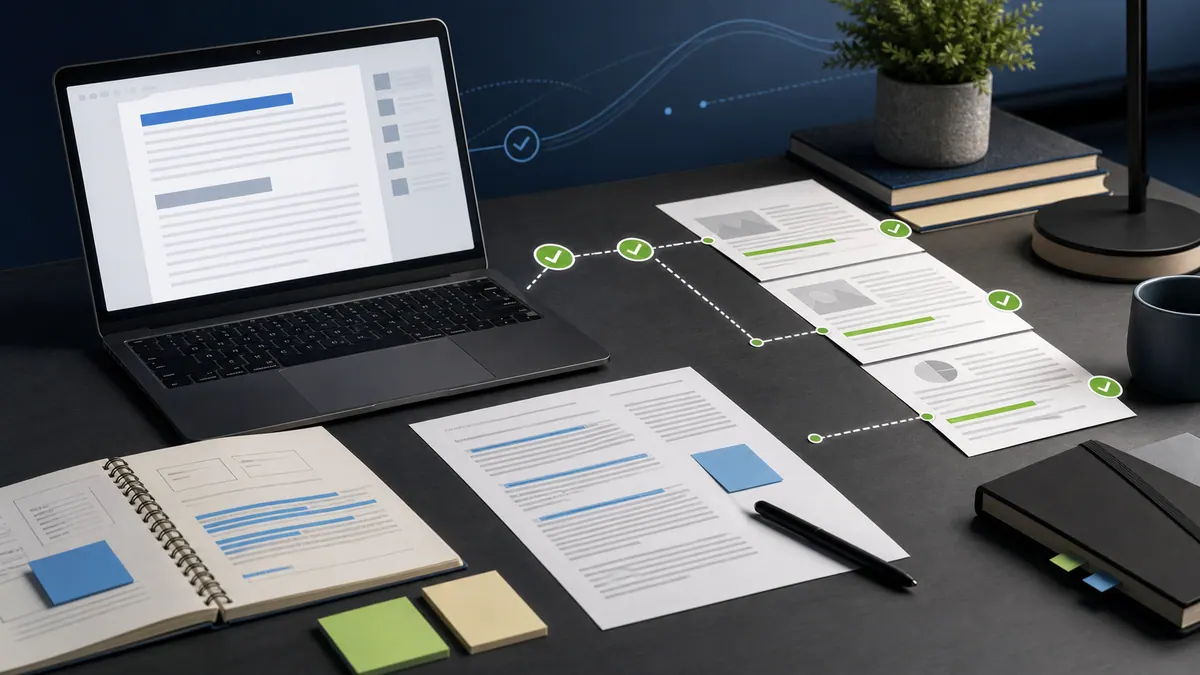
A source-of-truth pass turns a fluent AI draft into accountable writing by tying claims back to real sources, decisions, and constraints.
Fluency Is Not Grounding
AI-assisted drafts can sound confident before they are connected to anything real.
The structure may look complete. The headings may be tidy. The paragraphs may move with a professional rhythm. But when a reader slows down, the draft can start to feel strangely weightless. Claims appear without a source. Advice arrives without a situation. Numbers, examples, and comparisons sound plausible, but no one has checked where they came from.
That is not only a style problem. It is a trust problem.
The source-of-truth pass is the edit that brings the draft back to reality. It asks one direct question of every important sentence: what is this based on?
What Counts As A Source Of Truth?
A source of truth is the specific place your writing can point back to when a reader asks, "How do you know?"
It might be a product spec, a customer interview, a support ticket, a policy document, a dataset, a contract, a transcript, a meeting decision, a style guide, a direct observation, or a subject-matter expert's review.
It can also be a clearly named constraint.
For example: "This workflow is for a five-person content team publishing weekly articles" is a source of truth because it defines the conditions. The advice can now be tested against that situation.
Without a source of truth, an AI draft often defaults to broad statements that are difficult to disagree with and difficult to use.
Mark The Claims Before You Rewrite
Before polishing the language, mark the claims.
Look for sentences that assert, compare, recommend, explain cause and effect, describe a process, or imply risk. Those are the places where grounding matters most.
Underline sentences like:
- "Most teams struggle with AI detection because their content lacks authenticity."
- "This approach improves reader trust."
- "AI detectors often misread polished human writing."
- "A three-step workflow is enough for most marketing teams."
- "Students should use this method before submitting work."
Some of these claims may be useful. Some may be too broad. Some may need evidence. Some may need to be softened. The point is to stop treating fluent sentences as finished sentences.
Give Each Claim A Home
After you mark the claims, give each one a home.
A home might be a link, a note, a quote, a policy, a screenshot, a product decision, a real example, or a line in your own brief. If you cannot find a home, the claim needs work.
You have four options:
- Support it with a real source.
- Narrow it until it is true in a specific context.
- Rewrite it as a possibility instead of a certainty.
- Cut it.
This is where AI-assisted writing starts to become accountable. The human editor is not only changing the sound of the draft. The editor is deciding what the draft is allowed to say.
Replace General Authority With Specific Conditions
Weak AI drafts often use general authority.
"Experts agree."
"Businesses are increasingly realizing."
"Research shows."
"Users prefer."
Those phrases may be true in some cases, but they ask the reader to accept authority without seeing it.
A source-of-truth pass replaces vague authority with conditions the reader can inspect.
Before: "Businesses are increasingly realizing that AI writing requires human oversight."
After: "For teams publishing customer-facing content, human oversight is where product details, legal constraints, tone standards, and audience-specific examples enter the draft."
The second sentence does not pretend to speak for every business. It names the situation. It explains why oversight matters. It gives the reader something concrete to evaluate.
Build A Claim Map
For important pieces, create a simple claim map.
Use three columns:
- Claim: what the draft says.
- Source: where the claim comes from.
- Edit decision: keep, narrow, qualify, expand, or cut.
This does not need to become a formal research process for every blog post. It can be a working note. The value is that it makes invisible editorial judgment visible.
A claim map helps you see when a draft is leaning too heavily on generic statements. It also helps teams review AI-assisted content without arguing only about tone. Instead of saying "this feels AI-written," reviewers can say, "this claim does not have a source," or "this recommendation is too broad for our actual audience."
Anchor Examples In Real Use Cases
Examples are one of the fastest ways to make AI-assisted writing feel grounded.
But generic examples can be just as weightless as generic claims.
"A company might use AI to create blog posts" does not give the reader much. It is true, but thin.
A stronger example has a real shape: "A three-person SaaS marketing team uses AI to draft a changelog explainer, then a product manager checks feature names, a support lead adds customer language, and an editor removes claims that go beyond the release notes."
Now the example has constraints. It has roles. It has a source document. It shows what human review actually adds.
That kind of specificity is difficult to fake because it depends on editorial knowledge, not just phrasing.
Do Not Invent Precision
Grounding a draft does not mean adding fake precision.
If you do not have a number, do not invent one. If you do not know whether a claim is true across industries, do not imply that it is. If you are describing an internal process, do not make it sound like a universal rule.
Trustworthy writing is often more modest than AI first drafts.
It says "in this context."
It says "based on these examples."
It says "this may help when..."
It says "this needs review if..."
That kind of qualification does not weaken the writing. It makes the writing easier to trust.
Use AI For Sorting, Not Certainty
AI can help with the source-of-truth pass, but it should not become the source of truth.
You can ask it to identify unsupported claims, suggest places where examples would help, or convert broad statements into narrower versions. You can ask it to make a checklist from your brief. You can ask it to compare a draft against a style guide or product note that you provide.
But if the model supplies a fact, statistic, citation, legal interpretation, medical claim, policy detail, or product capability, verify it outside the model before publishing.
The useful role of AI here is sorting attention. It can help you see where the draft needs grounding. It cannot replace the grounding itself.
A Practical Source-of-Truth Pass
Use this pass after the draft has a rough structure and before the final style edit.
- Highlight every factual claim, recommendation, comparison, and risk statement.
- Write the source of truth beside each important claim.
- Narrow claims that are true only in a specific context.
- Replace vague authority phrases with inspectable evidence or conditions.
- Add one concrete example for every major recommendation.
- Cut claims that sound confident but cannot be supported.
- Run the final draft through a voice edit only after the claims are grounded.
This order matters. If you polish first, you may become attached to sentences that should be changed. Grounding before polish keeps the draft honest.
The Real Humanizer Is Accountability
Writers often talk about humanizing AI content as if the main task is making sentences sound less automated.
Voice matters. Rhythm matters. Specific language matters. But the deeper human layer is accountability.
A human editor knows what the draft is allowed to claim. A human editor understands the audience, the context, the tradeoffs, and the consequences of being wrong. A human editor can say, "We do not know that," or "This needs a source," or "This is true only for this reader."
That is what makes AI-assisted writing worth reading.
Not hidden authorship.
Not detector theater.
A draft that knows where its claims came from, and a writer willing to stand behind them.