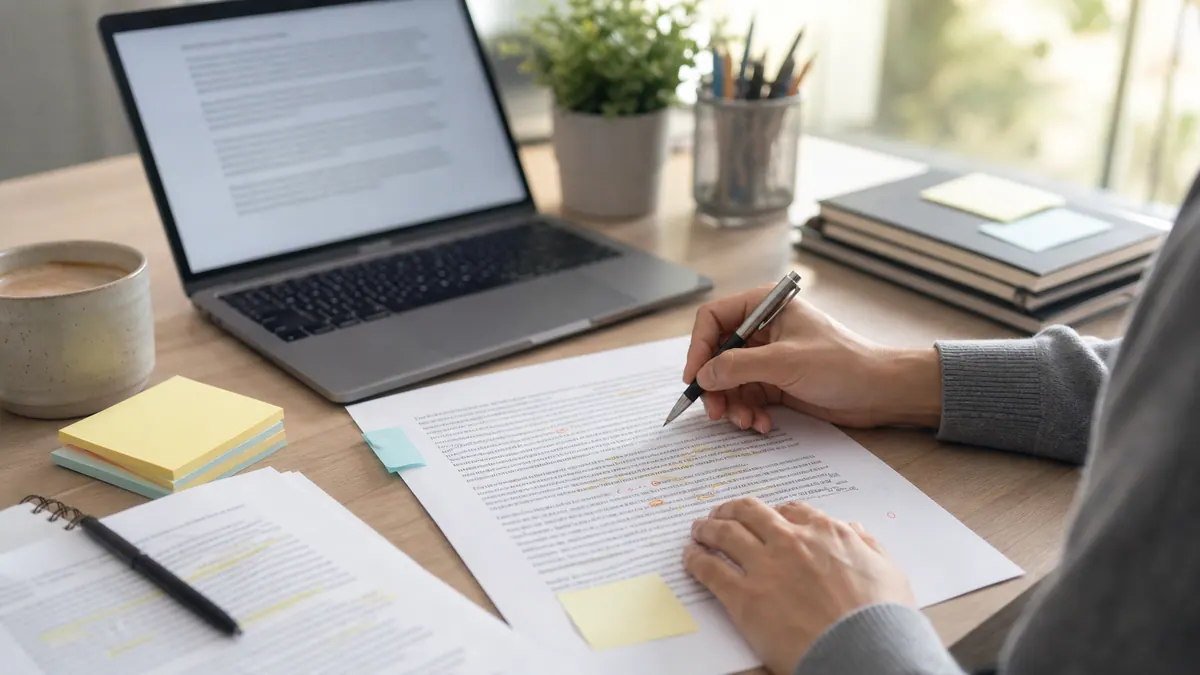
A texture pass makes AI-assisted writing feel more real by adding concrete moments, imperfect details, and situation-specific language without forcing personality.
Smooth Writing Is Not Always Convincing
AI-assisted drafts often read cleanly. The grammar is stable, the transitions are tidy, and the paragraphs move in a reasonable order.
That smoothness can be useful at the start. It gives you material to shape. But when every sentence arrives polished in the same way, the piece can feel strangely weightless.
It explains the idea without touching the surface of real life.
A reader may not say, "This sounds like AI." They may say something more ordinary: "This feels generic."
Generic writing usually lacks texture.
Texture is the small evidence that a piece has been revised by someone who knows where the advice will be used. It is the detail that shows friction, the example that carries a real constraint, the sentence that admits where the neat version breaks down.
The texture pass is a focused revision round for adding that kind of substance.
What Texture Means In A Draft
Texture is not decoration.
It is not adding random anecdotes, jokes, slang, or personal confessions so the writing seems more human. Forced personality often makes a draft worse because it draws attention to itself.
Useful texture does something for the reader.
It makes a claim easier to picture. It shows where advice applies. It names a tradeoff. It lets the reader feel the difference between a general principle and a real situation.
For example, a smooth draft might say:
"Review your AI-generated content carefully before publishing."
A textured revision might say:
"Before publishing, read the draft once as the person who has to act on it tomorrow. If the article tells a sales manager to 'improve follow-up quality' but never shows what a better follow-up email looks like, the advice is still floating."
The second version gives the reader a role, a moment, and a test. It has more grip.
Start With The Most Generic Sentences
The texture pass begins by finding sentences that could appear in almost any article on the topic.
Look for lines like:
- "In today's fast-paced world, quality content is more important than ever."
- "Businesses need to adapt to changing customer expectations."
- "AI can help improve efficiency and productivity."
- "It is important to maintain authenticity and trust."
- "Writers should use clear communication to engage their audience."
These sentences are not always false. That is part of the problem. They are so broadly true that they barely help.
During the texture pass, do not only ask whether the sentence is correct. Ask whether it gives the reader anything they did not already have.
If the answer is no, the sentence needs a detail, a constraint, an example, or a sharper replacement.
Add A Place Where The Advice Happens
One of the fastest ways to add texture is to give advice a setting.
Not a fictional scene with dramatic flourishes. Just a practical place where the idea would actually be used.
"Use more specific examples" becomes stronger when you name the moment:
"When you are revising a product comparison page, do not just say one tool is easier to use. Show the exact task: importing a CSV, inviting a teammate, fixing a billing mistake, or finding the setting a new user always misses."
Now the advice has a surface. The reader can test it.
Settings can be small:
- a founder rewriting a homepage before a launch
- a student turning research notes into an argument
- a content lead reviewing five drafts on a deadline
- a support manager editing a help article after a confusing ticket
- a recruiter trying to make a job description less interchangeable
When the setting is specific, the language usually becomes more useful on its own.
Name The Friction
AI drafts often describe best-case workflows.
They tell the reader what to do as if time, politics, uncertainty, budget, and competing priorities do not exist.
Texture appears when you name the friction.
Instead of:
"Create a content review process that ensures every draft aligns with your brand voice."
Try:
"If three people review every draft, brand voice can turn into a tug-of-war. Choose one final owner before the draft is written, then let the other reviewers comment on accuracy, missing context, or customer risk."
That version feels more real because it admits the problem hidden inside the recommendation.
Readers trust writing that understands why good advice is hard to follow.
Use Concrete Nouns Before Bigger Claims
Abstract language is not bad. You need words like trust, clarity, quality, risk, and authority. But if a paragraph stays abstract for too long, it starts to blur.
A texture pass anchors abstract claims in concrete nouns.
Instead of saying, "Add evidence to improve credibility," ask what kind of evidence belongs in this exact piece.
Is it a screenshot, a support ticket pattern, a pricing example, a quoted objection from a sales call, a source link, a before-and-after paragraph, a rubric requirement, or a product limitation?
The concrete noun makes the claim inspectable.
"Add evidence" is advice.
"Add the two customer objections your sales team hears every week" is a task.
Keep Imperfection Useful
Human writing is not convincing because it is messy. It is convincing because it has judgment.
Do not add typos, awkward phrasing, or fake hesitation just to make an AI-assisted draft seem less polished. That misunderstands the goal.
The useful kind of imperfection is not sloppiness. It is proportion.
A textured draft can admit:
- where a tactic will not work
- which readers need a different approach
- what the author is deliberately leaving out
- where the data is limited
- what tradeoff comes with the recommendation
That kind of imperfection makes the writing more credible because it stops pretending one paragraph can solve every version of the problem.
Replace Personality With Point Of View
Many people try to humanize AI writing by adding "voice."
Sometimes that works. Often it becomes decoration: a casual aside, a dramatic metaphor, or a punchy sentence that does not change the substance.
Point of view is stronger than personality.
A point of view tells the reader what the writer believes after making a choice.
For example:
"AI drafts should be edited carefully" is neutral.
"Do not start by polishing the wording. First decide what the draft is responsible for proving" is a point of view.
The second sentence has texture because it prioritizes one action over another. It reveals judgment.
Readers do not need every article to be quirky. They need the writing to make choices.
Run A Texture Checklist
After revising the draft, scan each section with a simple checklist.
- Does this section include at least one concrete situation?
- Does it name the reader's likely constraint?
- Does it replace at least one broad benefit with a visible example?
- Does it clarify what this advice is not saying?
- Does it include a decision, tradeoff, or test the reader can use?
You do not need every paragraph to carry all five. Too much detail can become clutter.
The goal is balance: enough texture that the article feels grounded, not so much that the main idea gets buried.
A Short Before-And-After
Before:
"AI-generated drafts often lack human nuance, so writers should revise them with more detail and authenticity before publishing."
After:
"If an AI draft says your onboarding flow is 'simple and intuitive,' stop there. Add the moment that proves it: the new account owner uploads a spreadsheet, invites two teammates, fixes one column error, and still reaches the dashboard without opening a help article."
The after version does not rely on a louder voice. It gives the claim something to stand on.
Texture Makes Writing Accountable
The texture pass works because it makes a draft answer to reality.
Instead of letting smooth sentences carry the piece, it asks for situations, friction, examples, constraints, and decisions.
That is what many AI-assisted drafts are missing. Not fluency. Not grammar. Not even structure.
They are missing the small signs that someone has checked whether the advice survives contact with a real reader's work.
When you revise for texture, you do more than make the writing sound human.
You make it useful enough to deserve the reader's trust.