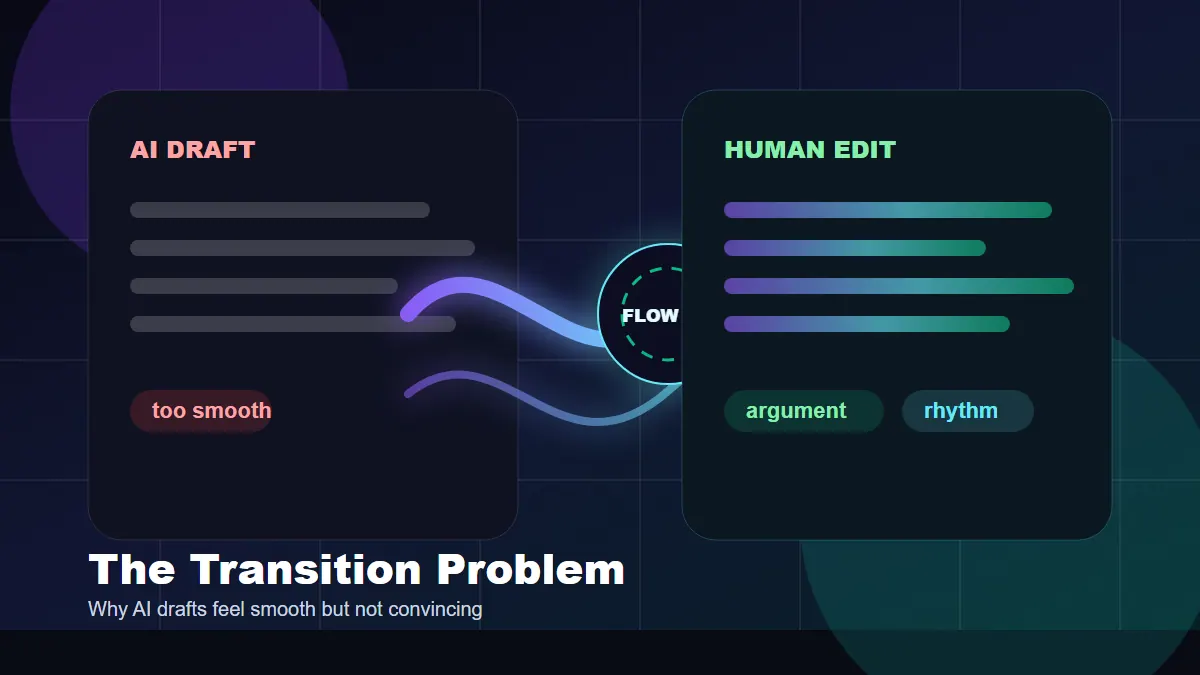
A lot of AI writing has a strange flaw: it moves smoothly from sentence to sentence while somehow failing to move the reader. The transitions are present, but the thinking underneath them is thin.
Smooth Is Not the Same as Logical
AI drafts are good at connective language. They know how to say furthermore, however, in addition, on the other hand, and therefore. The problem is that those words can create the impression of structure without actually earning the movement.
A human reader can feel the difference. A real transition does not merely announce that a new point is arriving. It explains why the next point belongs here. It carries tension, contrast, consequence, escalation, or a change in angle.
That is why a draft can look polished and still feel oddly weightless. The sentences are lined up. The argument is not.
The Detector Angle
AI detectors do not read like humans, but many of the patterns that make a reader suspicious also leave algorithmic fingerprints: even paragraph lengths, predictable connectors, generic claims, and unusually tidy progression. A draft that glides too neatly may feel less like a person reasoning and more like a machine completing a template.
The fix is not to make the writing messy for its own sake. The fix is to make the movement between ideas intentional. Human writing has shape because the writer is deciding what the reader needs next.
The Four Kinds of Real Transitions
Most weak transitions can be improved by asking what kind of relationship the next paragraph has to the previous one.
- Cause: This happened, so now this follows.
- Contrast: That is true, but it is incomplete without this.
- Escalation: The first problem is visible; the deeper problem is underneath.
- Example: The claim becomes believable when it touches a real case.
If you cannot name the relationship, the transition may be decoration. Decoration is easy to generate. Reasoning is harder to fake.
Before and After
AI-smooth: AI tools can help teams write faster. Furthermore, they can improve productivity. However, there are risks. Therefore, teams should use them responsibly.
Human-edited: Speed is the obvious benefit of AI writing tools. The harder question is what happens after the draft appears. If nobody owns the argument, the team may publish faster without saying anything sharper.
The second version does not simply swap words. It creates a real turn. It moves from benefit to consequence. The reader knows why the next sentence exists.
Look for Fake Connective Tissue
When editing an AI draft, scan for transitions that could be removed without changing the logic. If furthermore disappears and nothing breaks, the word was probably filler. If however appears but no real contradiction follows, the paragraph is performing nuance without having any.
Common warning signs include:
- Every paragraph begins with a formal connector.
- The draft uses contrast words without real contrast.
- Examples arrive after claims but do not change the reader's understanding.
- The conclusion repeats the introduction instead of resolving a tension.
- Each section could be rearranged without the argument collapsing.
Build an Argument Spine
A strong article has a spine: a sequence of necessary moves. Before polishing sentences, write the spine in plain language. For example:
- AI drafts often sound fluent.
- Fluency can hide weak reasoning.
- Readers notice when paragraphs do not truly depend on each other.
- Better transitions reveal cause, contrast, escalation, or example.
- Editing the transitions makes the whole piece more human and more persuasive.
Once the spine is clear, the transitions become easier. You are no longer sprinkling connective words over a pile of points. You are guiding the reader through a sequence.
The One-Sentence Test
After each paragraph, ask: What did this paragraph make possible that was not possible before?
If the answer is nothing, the paragraph may be redundant. If the answer is vague, the transition into the next paragraph may need work. A paragraph should change the reader's position, even slightly. It should add a fact, sharpen a distinction, complicate a claim, or prepare a decision.
How to Humanize Transitions
Try replacing generic transition words with actual thinking:
- Instead of Furthermore, write what the new point adds.
- Instead of However, name the assumption being challenged.
- Instead of In conclusion, show what changed by the end.
- Instead of It is important to note, prove why the note matters.
This does not mean never using simple connectors. Sometimes a plain but is perfect. The point is that the connector should serve the thought, not replace it.
Why This Matters for AI-Assisted Writing
The future of writing with AI will not belong to people who accept fluent drafts unchanged. It will belong to people who can see where fluency is pretending to be insight.
Humanizing a draft is not only about changing sentence rhythm or swapping vocabulary. It is about restoring intention. Why this point? Why now? Why after that? Why should the reader keep following?
When the transitions become real, the piece stops sounding like a generated overview and starts sounding like someone thinking in public.
A Practical Editing Pass
Before publishing your next AI-assisted draft, do one transition pass:
- Write the main point of each paragraph in the margin.
- Draw an arrow between each paragraph and name the relationship.
- Cut any paragraph that does not change the reader's understanding.
- Replace decorative connectors with specific cause, contrast, escalation, or example.
- Read the article aloud and listen for places where the movement feels too automatic.
The result will not merely pass as more human. It will be better writing.