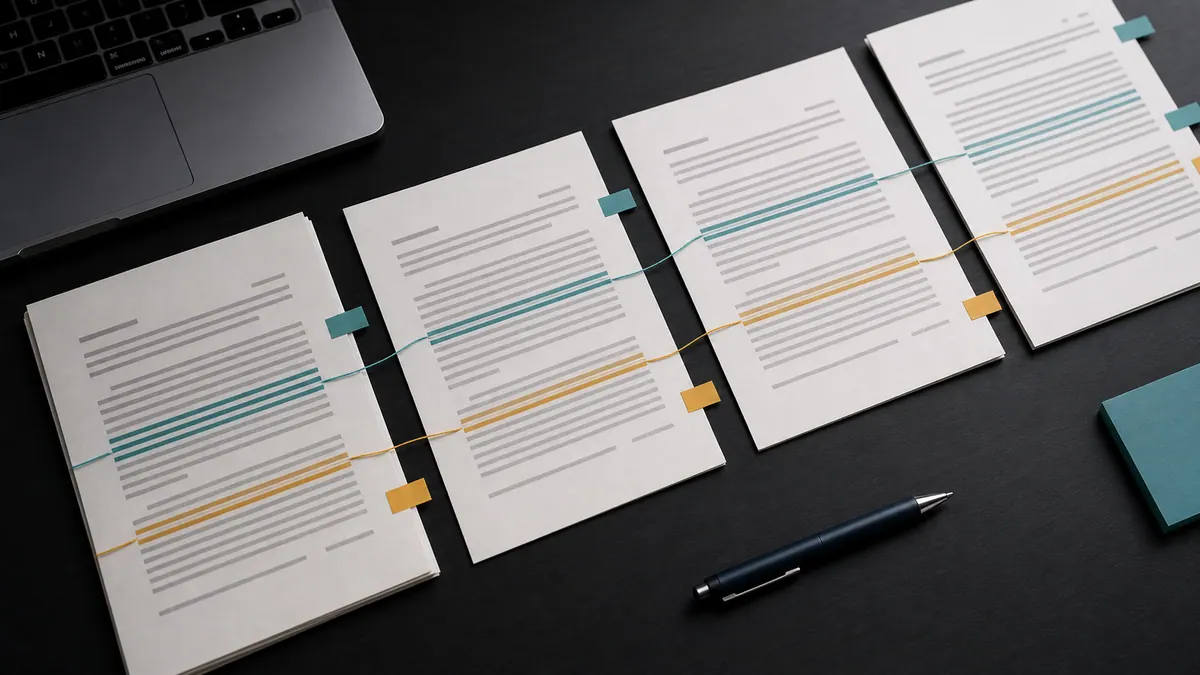
A thread drift review catches the moment a long AI-assisted draft starts following its own momentum instead of the original point, reader promise, or evidence trail.
Long AI-assisted drafts can lose the point without looking messy.
The sections may be polished. The headings may sound related. The transitions may be smooth enough that nothing feels obviously broken. But by the end, the piece may be answering a slightly different question from the one it promised at the beginning.
That problem is thread drift.
Thread drift happens when a draft begins with one purpose, then slowly follows adjacent ideas, generic explanations, or model-friendly summaries until the original argument becomes blurry. The writing still sounds coherent sentence by sentence, but the whole piece stops pulling in one direction.
A thread drift review is a final editing pass for that problem.
It asks: does every section still serve the same point, reader promise, and evidence trail?
Smooth Sections Can Still Lose The Argument
AI writing is good at local smoothness.
It can make one paragraph follow another. It can turn a rough note into a reasonable section. It can produce a conclusion that sounds balanced. That fluency is useful, but it can hide a larger issue: the sections may be individually acceptable while the draft as a whole becomes unfocused.
A guide about editing AI drafts might drift into a general essay about productivity. A policy note about responsible AI use might drift into broad technology optimism. A product page about one workflow might drift into a list of every possible feature. A student explanation might drift from process transparency into detector-score panic.
The draft does not fail because the sentences are bad.
It fails because the thread has loosened.
Write The Through-Line In One Sentence
Before reviewing the draft, write the through-line in one sentence.
Use this structure:
"This draft helps ___ understand ___ so they can ___ without ___."
For example:
"This draft helps a content editor understand where an AI-assisted article loses focus so they can tighten the argument without rewriting the whole piece."
Or:
"This draft helps a student explain their writing process so they can respond to uncertainty without treating a detector score as proof."
The sentence is not marketing copy. It is a control point.
Every heading, example, warning, and conclusion should still connect to it. If the through-line is hard to write, the draft may not have one clear job yet.
Check Every Heading Against The Same Promise
Headings are where thread drift becomes easier to see.
Read only the headings in order. Ignore the paragraphs beneath them for a moment.
Ask whether the heading sequence tells the same story as the through-line.
Look for headings that introduce a new topic too late, repeat the same point under a new label, promise a section the body does not deliver, or sound like they belong in a different article.
Then ask a stricter question:
If a reader saw only these headings, would they understand what this draft is trying to help them do?
If not, the headings are not just labels. They are symptoms of drift.
Mark Helpful Sentences That Belong Elsewhere
Some drifting sentences are not bad sentences.
They are useful, clear, and even interesting. They simply belong to a different draft.
That is why thread drift can be hard to edit. Removing a weak sentence is easy. Removing a good sentence that pulls the draft sideways is harder.
During the review, mark sentences that make you think, "This is true, but is it the point?"
Common examples include:
- a broad history paragraph that slows down a practical guide
- a detector warning inside an article about editorial workflow
- a feature explanation inside a post about reader trust
- a generic best-practices section that could appear in any AI writing article
- a conclusion that introduces a new argument instead of resolving the current one
Do not delete everything immediately. Move these sentences into a parking lot first. If the draft becomes clearer without them, you have found drift.
Track Terms That Change Meaning
Another sign of drift is a key term that quietly changes meaning.
A draft may begin by using "humanize" to mean preserving meaning while making prose more natural, then later use it to mean hiding AI involvement. It may use "evidence" to mean source links in one section and personal confidence in another. It may use "quality" to mean accuracy, then later to mean style.
Those shifts make the draft feel slippery.
Choose three to five important terms and track how the draft uses them.
For AI-assisted writing, the terms might be "detector," "claim," "source," "human," "rewrite," "review," "policy," or "risk."
If a term changes meaning, define it more clearly or split it into two words. Precision keeps the thread tight.
Reconnect Examples To The Main Claim
Examples should not just decorate the article.
They should prove, clarify, or apply the main claim.
During a thread drift review, ask what each example is doing. Is it showing the reader how to act? Is it making an abstract point concrete? Is it testing an edge case? Is it adding evidence? Or is it only there because the draft needed something specific?
If an example does not connect back to the through-line, revise the setup around it.
Instead of dropping in a generic example, write the bridge:
"This matters because..."
"In this case, the drift happens when..."
"The reader needs this example because..."
A good bridge can save a useful example. If you cannot write the bridge, the example may belong somewhere else.
Use AI To Find Drift, Not To Decide The Point
AI can help with a thread drift review if the task is narrow.
Give the model your through-line and ask it to flag sections that do not support it, repeat earlier points, introduce side topics, or change the meaning of important terms.
Ask for evidence from the draft, not vague feedback.
A useful prompt might be:
"Read this draft against this through-line. List the sections that drift away from it. For each one, quote the heading, explain the drift in one sentence, and suggest whether to cut, move, or refocus it."
Then make the final decision yourself.
The model can notice patterns, but it should not define the point for you. If you let it rewrite the purpose every time the draft wobbles, you may end up with a smoother version of the same drift.
Keep A Small Drift Log
When you edit long AI-assisted drafts often, patterns repeat.
Keep a small drift log with three columns:
- where the draft drifted
- what pulled it off course
- what edit fixed it
You may notice that your drafts drift whenever the source material is thin, whenever the prompt asks for too many goals, whenever the outline has duplicate sections, or whenever the conclusion is generated separately from the body.
That log makes the next prompt better. It also makes the human editing process easier to explain if someone asks how the draft was reviewed.
The Final Draft Should Keep Its Promise
A strong AI-assisted draft does not need to cover every adjacent idea.
It needs to keep its promise.
The reader should feel that the beginning, middle, and end belong to the same task. The examples should point toward the same outcome. The vocabulary should stay stable. The conclusion should return the reader to the original job with more clarity than they had at the start.
That is what a thread drift review protects.
It turns local polish into whole-draft coherence.
And whole-draft coherence is one of the clearest signs that a human editor has done the work after the AI draft was generated.
Review Your Draft in One Workspace
Use AI Undetectable to evaluate writing patterns, revise awkward phrasing, and compare the result before you publish. Detector scores are signals, so keep the final factual and editorial review in human hands.
Open AI Humanizer