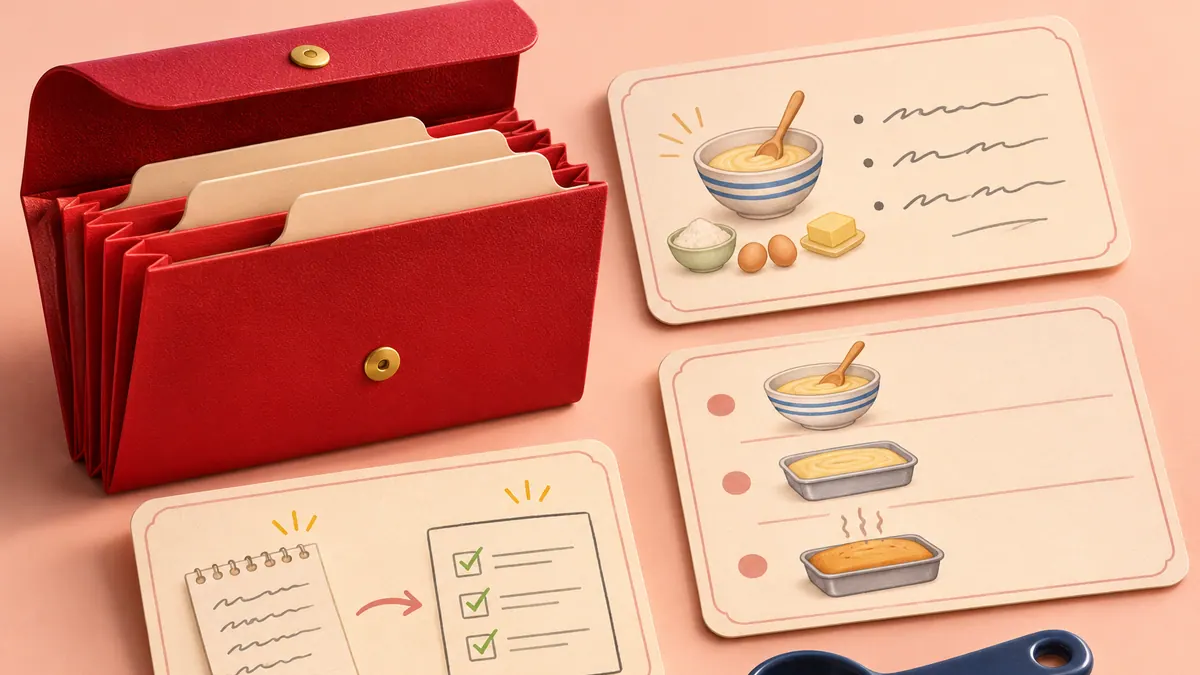
A handwritten recipe can make perfect sense to the person who cooks it and leave everyone else guessing. “Usual tin,” “until ready,” and an ingredient added in the margin may be enough for its author. They are not enough for a new reader. AI can help organise those notes, but a smooth paragraph must not conceal what the notes never supplied.
The writer's task is to make a draft that separates confirmed information from questions. This complements our guide to turning interview notes into a factual profile: here, the source describes a procedure, so a missing detail can prevent a reader from carrying it out. The result below is an editing worksheet, not a tested recipe to cook from.
Keep a literal transcription beside the draft
Begin with a transcription that preserves the source's wording, crossed-out alternatives, and uncertainty. If a photograph is unclear, mark the unclear part rather than choosing the word that would make the recipe seem complete. Keep the original image available for comparison and get permission before sharing somebody else's personal notes.
Consider this fictional fragment:
“Lemon cake. One lemon, zest only. Usual mixture. Round tin. Batter thick. Ask Dana about oven setting. Drizzle after cooling. Less sweet version? Check.”
There is useful information here, but no complete ingredient list, quantities for the mixture, tin dimensions, cooking conditions, or drizzle method. A polished cake recipe would require evidence the fragment does not contain. Do not ask the model to “fill in the obvious gaps.” What seems conventional may belong to a different recipe.
Sort information before improving the sentences
Ask for three groups: what the notes state, what remains unclear, and what must be confirmed before the draft can become usable instructions. Keep the distinction visible even if an answer seems easy to guess.
- Stated: one lemon is mentioned; only its zest is specified; the tin is round; the batter is described as thick; the drizzle follows cooling.
- Unclear: what “usual mixture” means, which tin is intended, and whether the less-sweet version was tried or merely suggested.
- To confirm: the complete ingredients and amounts, the preparation sequence, the missing cooking details, and the drizzle ingredients and method.
“The batter is thick” describes an observation. It does not establish how thick it should be, how to correct it, or whether a batch is safe or successful. Preserve the observation without converting it into extra instructions.
Use a prompt that allows an incomplete answer
A useful request gives the model permission to stop short of a finished recipe:
“Organise these notes into an editorial draft. Use only the information provided. Do not add ingredients, quantities, temperatures, timings, substitutions, storage advice, or claims that the recipe was tested. Keep uncertainties explicit. Return confirmed details, a draft with clearly labelled gaps, and questions for the original cook. Do not present the result as ready to cook.”
Ask for the questions separately so the source owner can answer them without deciphering a polished draft. Keep the task narrow: transcription, organisation, and clearer wording. Recipe development and verification require additional work beyond rearranging sentences.
Turn each gap into an answerable question
“Please clarify the recipe” is too broad. “What ingredients and amounts are in the usual mixture?” points to a specific missing piece. Follow it with questions about the order of preparation, the tin dimensions, and the oven information Dana can confirm.
For the final note, ask: “Was the less-sweet version actually made, or was this an idea for another attempt?” Until answered, place it in a separate ideas section. Do not quietly substitute it into the main method. A suggestion, a remembered variation, and a tested change are different kinds of information.
Record each answer with its source and date. If two people remember different details, keep that disagreement visible and resolve it with the responsible recipe author. Do not ask AI to choose the more plausible account and then remove the uncertainty.
Edit the confirmed material without supplying the missing method
The fragment supports a short summary such as: “These notes describe a lemon cake using zest from one lemon, baked in a round tin, with a drizzle added after cooling. The mixture, tin size, cooking details, and drizzle method still need confirmation.”
It does not support: “Make a simple lemon sponge, bake until golden, and finish with a classic lemon glaze.” That version invents a cake type, a doneness description, and a glaze identity. It sounds natural while becoming less faithful to the source.
Once the missing information is confirmed, improve the wording around it. Name the ingredient instead of relying on “it,” split distinct actions into separate steps, and use consistent units. If a conversion is required, verify it separately and retain the original amount in your working record.
Give the final draft a factual review
Compare every ingredient, amount, action, and sequence against the confirmed source. Search for leftover placeholders and unresolved alternatives. Check that a heading such as “Tested family favourite” has evidence behind it rather than appearing because it sounds appealing.
A complete-looking manuscript still needs appropriate recipe and food-safety review. Our recipe rewrite review guide covers that separate stage. Keep an unverified draft out of the ready-to-cook collection, and ask the responsible author to approve the finished wording.
You can use AI Undetectable to refine the phrasing after the facts are fixed. Recheck the result against the source; clearer prose cannot confirm an ingredient or validate a method. The useful outcome is either a supported, reviewed recipe or an honest draft with precise questions still attached.