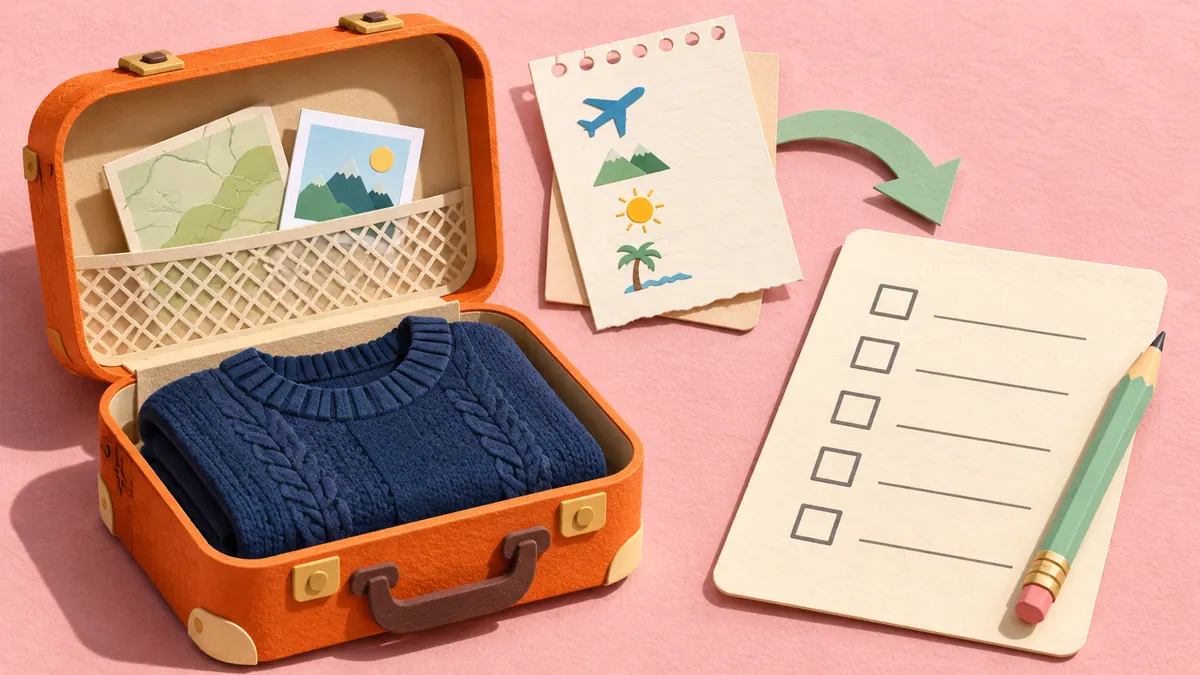
A packing list can look complete while quietly inventing the trip. You give an AI tool three nights, a work meeting, and a possible swim. It returns a checked bag, a formal dinner outfit, and a confident claim about the weather. The list is polished, but several items depend on plans you never supplied.
The writer's problem is organizing scattered trip notes into an actionable checklist while preserving what is confirmed and what remains undecided. This worked example complements our volunteer handover guide: both turn notes into actions, but a packing list also needs to distinguish an item from a decision. This is a fictional editing example, not destination-specific travel advice.
Start with a small source record
Write down the information you actually have before asking for recommendations. Include duration, planned activities, equipment you use, and arrangements already confirmed. Do not fill gaps simply to make the notes look tidy.
- Three nights away; travel home on the fourth day.
- One work meeting; ordinary work clothes are suitable.
- Walking around town on two afternoons.
- Swimming is possible, but not booked or decided.
- Accommodation confirms towels are provided; laundry availability unknown.
- Bring laptop, its charger, phone, and phone charger.
- Bag allowance and forecast have not been checked.
- No decision yet about bringing a second pair of shoes.
These notes support a useful first draft. They do not support a particular suitcase size, a guarantee of sunshine, or an assumption that there is a pool. Mark those gaps explicitly so the model has something more accurate to do than guess.
Request three separate sections
A single long list can blur necessities, suggestions, and unresolved questions. Ask for sections that retain those distinctions:
“Turn these notes into a concise packing checklist. Use three sections: Pack from confirmed plans, Optional if I decide, and Check before finalizing. Preserve supplied quantities and uncertainty. Do not invent weather, airline rules, accommodation facilities, or activities. Put new suggestions in the optional section and label them as suggestions. Use one action per line.”
You do not need to include a booking reference, address, passport number, or exact travel dates for this editing exercise. Placeholders are enough to test whether the structure works. Add private details only in the tools and records where you actually need them.
Compare a confident list with a faithful one
Overreaching draft: “Pack your permitted cabin suitcase, four formal outfits, swimwear for the hotel pool, a beach towel, and sandals for the sunny afternoons. You can wash clothes at the hotel, so leave spare clothes behind.”
Almost every line upgrades a guess into a fact. The suitcase is declared permitted without a checked allowance. Ordinary work clothes become formal outfits. A possible swim becomes a hotel pool visit. Towels are added despite the accommodation note, while laundry is treated as available.
Source-preserving checklist:
- Pack from confirmed plans: work clothes for the meeting; walking clothes suitable for the forecast once checked; laptop and its charger; phone and its charger.
- Optional if I decide: swimwear if swimming becomes part of the plan; second pair of shoes if needed for the chosen activities.
- Check before finalizing: baggage allowance for the actual booking; current forecast; whether laundry is available if clothing quantities will depend on it; whether swimming is happening.
The result deliberately leaves some decisions open. That is a useful feature when the source is incomplete. The traveler can now answer a short set of questions instead of discovering hidden assumptions after packing.
Make quantities a separate editing pass
“Three nights” does not by itself determine how many shirts someone needs. Travel days, reworn clothing, personal preferences, activities, and laundry plans all affect quantities. Ask the tool to preserve your chosen counts, or to propose counts explicitly as suggestions for your review.
For example, “Suggest clothing quantities for these plans; label every proposed number and explain the assumption briefly” keeps the distinction visible. Once you choose a quantity, move it into the confirmed list. Do not leave both a general item and a duplicate counted item unless they serve different purposes.
Read the final list as instructions to yourself. “Chargers” may be too vague when two devices use different cables. “Laptop charger” and “phone charger” are easier to check individually. Conversely, splitting every sock into its own line makes the document harder to use. Choose the detail that prevents a realistic omission.
Keep verification tasks out of the suitcase section
“Check bag allowance” is an action before packing, not an object to pack. Put it where you will see it before selecting luggage. Confirm current rules through the relevant carrier or official source for your actual journey; a generic writing draft cannot establish them.
Similarly, “check forecast” should not silently become “pack raincoat” unless you choose that response. You may decide a light layer is useful regardless, but label that as your decision. The checklist should record the reasoning boundary without turning into a long travel essay.
Do one final source-to-list check
Compare every confirmed line with your notes or a decision you have since made. Then check that each unresolved point still appears somewhere. An elegant rewrite that deletes “laundry unknown” can be less useful than a rough note that keeps it visible.
Our guide to preserving uncertainty explains this distinction in prose. You can use AI Undetectable to explore clearer wording, then inspect the result against your source record. A detector score cannot tell you whether your bag meets an allowance or a facility exists.
Before using the checklist, remove rejected suggestions, resolve the questions you can, and leave remaining unknowns labeled. A good final list tells you what to pack, what you might pack, and what still needs a decision. It earns its usefulness through accurate boundaries rather than confident completeness.