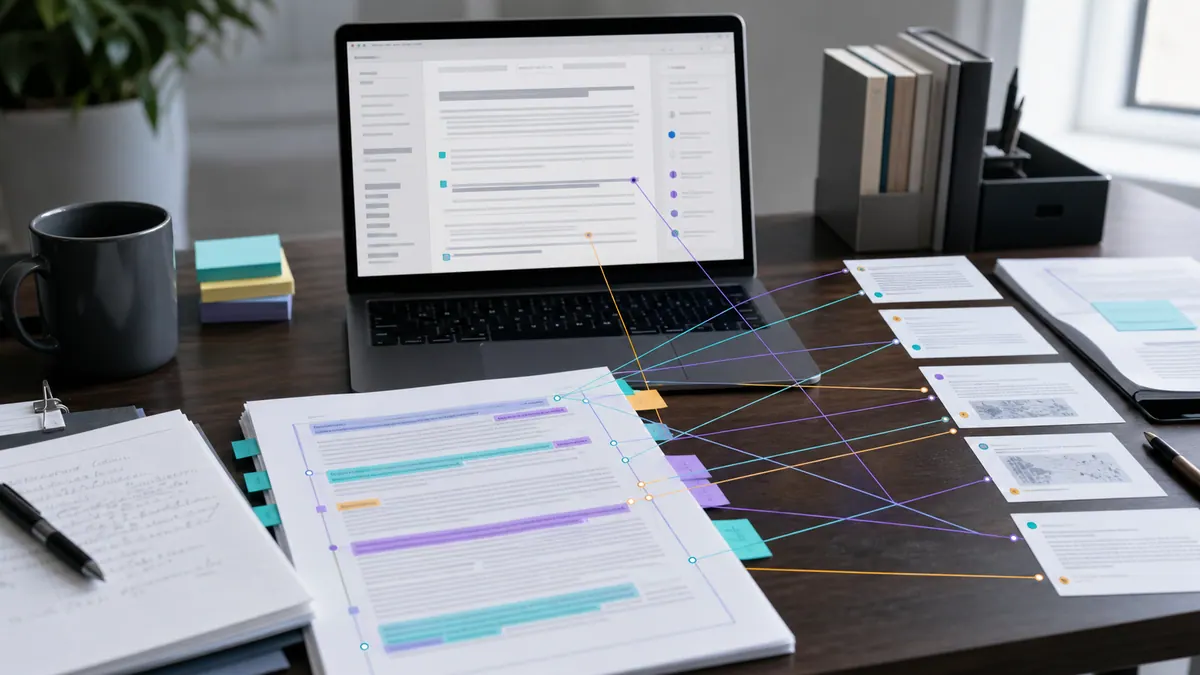
An evidence map pass keeps AI-assisted writing trustworthy by connecting important claims to sources, examples, owners, and review notes before publication.
AI Drafts Can Sound Supported Before They Are Supported
One of the hardest things about reviewing AI-assisted writing is that support can look implied.
The draft sounds organized. The paragraphs move cleanly. The examples feel plausible. The recommendations arrive with confidence. A busy reviewer may read that fluency as evidence that the work underneath it is solid.
That is the danger.
AI can produce a claim that sounds like it belongs in a finished article before anyone has checked where the claim came from, whether the source still says that, whether the example is real, or whether the conclusion is stronger than the evidence allows.
The evidence map pass is a practical review step for that gap. It asks you to mark the claims that carry weight and connect each one to the material that supports it.
This is not academic busywork. It is a way to keep AI-assisted writing accountable when the draft is moving faster than the verification process.
Start With Claims That Change What A Reader Believes
Not every sentence needs a source map.
A sentence that introduces a section, summarizes a workflow, or explains what the article will cover usually does not need heavy review. The map should focus on claims that change what a reader believes or what they might do next.
Look for sentences that contain numbers, comparisons, risk statements, product promises, legal or policy implications, broad claims about people, or advice that could create consequences if it is wrong.
For example:
- "AI detectors often produce false positives for non-native English writers."
- "This workflow reduces review time for marketing teams."
- "Students can safely use this approach under most academic policies."
- "Humanized text is harder for detectors to identify."
- "Customers prefer shorter support articles."
Each of those claims may be useful. Each also needs a traceable basis before it should appear as a confident statement.
Create A Simple Map, Not A Research Database
An evidence map can be lightweight.
You do not need a complex citation system for every blog post or landing page. A simple table is often enough:
- Claim
- Source or basis
- Owner or reviewer
- Confidence level
- What changed after review
The point is to make the support visible. If a claim comes from a study, link the study. If it comes from internal customer data, name the report or dashboard. If it comes from product knowledge, name the product owner. If it is judgment rather than evidence, say that clearly.
A traceable judgment can still be useful. An unsupported fact pretending to be certain is the problem.
Separate Sources From Examples
AI drafts often use examples as if they were evidence.
An example can help a reader understand a claim, but it does not automatically prove the claim. A made-up workplace scenario can show how a workflow might operate. It cannot prove that the workflow saves time. A sample essay paragraph can show a revision technique. It cannot prove the technique will satisfy a specific school policy.
During the evidence map pass, label the role of each supporting item.
Source: material that supports whether a claim is true.
Example: material that helps the reader understand the claim.
Reviewer judgment: a human decision about whether the claim is fair, useful, and appropriately limited.
When those roles blur, AI-assisted writing gets less trustworthy. Readers may be shown a polished scenario and assume it reflects proven reality.
Add Limits Where The Evidence Is Narrow
The map often reveals that a claim is not wrong, but it is too broad.
Maybe the source applies only to one audience. Maybe the data is old. Maybe the product result came from a small internal test. Maybe the expert review supports a cautious recommendation, not a universal promise.
That does not mean the sentence has to be deleted. It means the sentence should be narrowed.
Instead of "AI detectors penalize non-native English writers," you might write, "Some studies and classroom reports have raised concerns that AI detectors can misclassify writing from non-native English speakers, so detector scores should not be treated as standalone proof."
The second version is longer, but it carries the right level of confidence. It also gives the reader a better mental model: the issue is real enough to matter, but the evidence still needs careful handling.
Track What Changed After Review
The most useful evidence maps do not only record sources. They record decisions.
After review, note what changed:
- Unsupported number removed.
- Broad claim narrowed to a specific audience.
- Product promise changed into a workflow recommendation.
- Example replaced with a real customer-safe scenario.
- Legal-sensitive wording sent for expert review.
- Detector claim reframed to avoid treating scores as proof.
This small change log helps teams learn. It also makes repeated AI drafting safer because reviewers can see the kinds of claims that usually need pressure.
Over time, the map becomes a training record for the team, not just a cleanup tool for one article.
Use AI To Find Claims, Not To Approve Them
AI can help with the evidence map pass if you give it a narrow job.
Ask it to identify claims that need support, separate facts from advice, flag vague authority, or suggest where a sentence may be too broad. That can save time, especially in long drafts.
But do not let the same tool that generated the confidence also approve the evidence behind it.
A better prompt is:
"List the claims in this draft that require evidence or expert review. Do not verify them. Create a table with claim, risk level, and what kind of source or reviewer is needed."
That keeps AI in the role of assistant, not judge. The final decision still belongs to the person or team responsible for publishing.
Make The Final Draft Show Its Work Quietly
The reader does not need to see your whole internal map.
They do need to feel its effect.
A mapped article has fewer unsupported leaps. It names limits more clearly. It distinguishes examples from proof. It avoids making detector scores sound more certain than they are. It tells readers when a recommendation depends on policy, context, or expert review.
That kind of writing may be less flashy than a draft full of clean certainty. It is also more durable.
The evidence map pass is a reminder that responsible AI-assisted writing is not just about sounding human. It is about being able to stand behind what the writing asks readers to believe.
Before you publish, choose the claims that matter, connect them to real support, narrow what needs narrowing, and keep a short record of what changed.
If the draft cannot show where its confidence came from, it is not ready to ask for the reader's trust.